Energy News  
Seeing In The Dark As Saturn Lights Up Iapetus

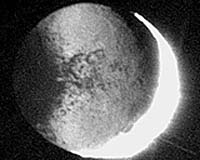
Saturn's moon Iapetus.

Pasadena CA (JPL) Dec 09, 2004
Never-before-seen features on the Saturn-facing part of Iapetus' bright trailing hemisphere are visible for the first time, including many dark spots, and a sharper view of a dark, circular structure that was first seen at very low resolution by NASA's Voyager 1 in 1980. Iapetus diameter is 1,436 kilometers (892 miles).

The image shows mainly the night side of Iapetus; part of the far brighter sunlit side appears at the right and is overexposed due to the long integration time of 180 seconds.

Despite this long exposure time, almost no blurring due to the spacecraft's motion is apparent. This technique for imaging the night side of Iapetus will be used again during a flyby on Jan. 1, 2005, when Cassini will pass 13 times closer to the icy moon.

The image was taken in visible light with the Cassini spacecraft narrow angle camera on Oct. 22, 2004, at a distance of 1.6 million kilometers (994,000 miles) from Iapetus, and from a Sun-Iapetus-spacecraft, or phase, angle of 161 degrees. The view is centered on 0.4 degrees north latitude, 317 degrees west longitude on Iapetus. The image scale is 9.4 kilometers (5.8 miles) per pixel.

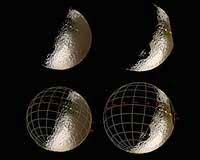
Cassini Brings A Waning Iapetus Into View

Community
Email This Article
Comment On This Article

Related Links
Cassini-Huygens at JPL
Cassini Imaging Team
SpaceDaily
Search SpaceDaily
Subscribe To SpaceDaily Express
Explore The Ring World of Saturn and her moons
Jupiter and its Moons
The million outer planets of a star called Sol
News Flash at Mercury


Memory Foam Mattress Review
Newsletters :: SpaceDaily :: SpaceWar :: TerraDaily :: Energy Daily
XML Feeds :: Space News :: Earth News :: War News :: Solar Energy News


Cassini Images Halo Around Titanic Moon Off Saturn
Pasadena CA (SPX) Dec 27, 2005
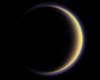
With its thick, distended atmosphere, Titan's orange globe shines softly, encircled by a thin halo of purple light-scattering haze.


  • Analysis N.M. Wants To Market Wind Power
  • Idaho Lab, Utah Company Achieve Major Milestone In Hydrogen Research
  • MIT, Columbia Begin New Energy Experiment
  • Europe Growing Dependent On Russian Energy: IEA

  • Brazil To Start Enriching Uranium Next Month: Official
  • Top Scientists Lash Australian States Over N-Waste 'Hysteria'
  • Nuclear Waste Dumps Will Become The Pyramids Of Our Age
  • France Gambles On Nuclear Energy Market


  • NASA Uses Remotely Piloted Airplane To Monitor Grapes


  • NASA's Famed B-52B "Mothership" Aircraft To Retire
  • EADS Faces Big Decision On Boeing Rival, Grapples With Internal Friction
  • Raytheon To Continue NASA Contract For Airspace Concepts Evaluation System
  • FAA And Raytheon To Modify FAA Contract To Provide Full LPV Performance For The WAAS

  • NASA plans to send new robot to Jupiter
  • Los Alamos Hopes To Lead New Era Of Nuclear Space Tranportion With Jovian Mission
  • Boeing Selects Leader for Nuclear Space Systems Program
  • Boeing-Led Team to Study Nuclear-Powered Space Systems

  • The content herein, unless otherwise known to be public domain, are Copyright 1995-2006 - SpaceDaily.AFP and UPI Wire Stories are copyright Agence France-Presse and United Press International. ESA PortalReports are copyright European Space Agency. All NASA sourced material is public domain. Additionalcopyrights may apply in whole or part to other bona fide parties. Advertising does not imply endorsement,agreement or approval of any opinions, statements or information provided by SpaceDaily on any Web page published or hosted by SpaceDaily. Privacy Statement