|
 |
 |
 |
 |
 |
 |
 |
 |

 |
Securing The American Power Grid
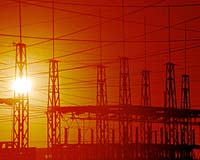
Ames IO (SPX) Jun 25, 2006 An Iowa State University research team led by Arun Somani, chair and Jerry R. Junkins professor of electrical and computer engineering, is working to develop a network of wireless sensors that could monitor the country's electricity transmission system. While the sensors could pick up suspicious activity at power poles, they'd be especially useful at quickly locating any breakdowns. That could allow power companies to react in time to prevent power disruptions from cascading into blackouts. And the monitoring system could also help power companies quickly locate problems when severe weather tears down electrical lines. With networks of sensors, "Power companies would have additional abilities to view their systems and that would assist in disaster recovery," Somani said. America has a lot of transmission lines, substations and generators that could use some monitoring. The Department of Energy reported the country had 157,810 miles of transmission lines in 2004. And the department reported that America's power plants produced 3.97 billion megawatt hours of electricity in 2004. The monitoring system depends on sensors housed in black boxes just a few inches across. Somani recently picked up one of the sensors inside Iowa State's Wireless and Sensor Networking Laboratory and showed off the electronics capable of watching out for conductor failures, tower collapses, hot spots and other extreme conditions. A tiny camera can also be mounted in the sensor to look for suspicious movements around power lines. The project is supported by a $400,000 grant from the National Science Foundation and $150,000 from Iowa State's Information Infrastructure Institute. The project's Iowa State research team also includes Manimaran Govindarasu, an associate professor of electrical and computer engineering; Murti Salapaka, an associate professor of electrical and computer engineering; and Zhengdao Wang, an assistant professor of electrical and computer engineering. Former Iowa State faculty member Vijay Vittal, now a professor of electrical engineering at Arizona State University, is also working on the project. Each of the researchers brings different specialties to the project. And it's not an easy project, Somani said. The researchers need to design a system that stands up to weather. They need to design sensors that can accurately monitor the power grid's electrical and mechanical characteristics. They need to find a way to monitor the area around electrical equipment for suspicious activity. They need to develop wireless communication networks so the sensors can send comprehensive data from far-flung areas to control centers. They need to design a diagnosis algorithm to accurately determine fault conditions and predict faults. They need to design a decision algorithm to reconfigure the power network to prevent or alleviate cascading failures. And they need to find ways to get electricity to the sensors because the electrical lines they're monitoring carry a different kind of power. Somani said the researchers are making good progress on developing a prototype system. He said the research team is also starting to talk to power companies about the possibility of testing the system on the electrical grid. And he said project has implications for national security. "With the increasing threat of terrorism around the world, more attention is being paid to the security of the transmission infrastructure," says a summary of the project. "Experiences in countries like Columbia, which has faced as many as 200 terrorist attacks on its transmission infrastructure per year, demonstrate the vulnerability of the power system to these kinds of events." Community Email This Article Comment On This Article Related Links Iowa State University The Long War - Doctrine and Application
 Subway Gas Terror Plot Story Two Years Old
 Washington (UPI) Jun 22, 2006
Reports currently roiling the airwaves about al-Qaida's design for a crude device to produce cyanide gas first surfaced more than two-and-a-half years ago. |
|
|

| The content herein, unless otherwise known to be public domain, are Copyright 1995-2006 - SpaceDaily.AFP and UPI Wire Stories are copyright Agence France-Presse and United Press International. ESA PortalReports are copyright European Space Agency. All NASA sourced material is public domain. Additionalcopyrights may apply in whole or part to other bona fide parties. Advertising does not imply endorsement,agreement or approval of any opinions, statements or information provided by SpaceDaily on any Web page published or hosted by SpaceDaily. Privacy Statement |