|
 |
 |
 |
 |
 |
 |
 |
 |

 |
Searching For Gravity's Wake In The Solar Wind
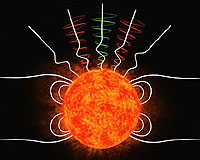
Paris - November 30, 1999 - New evidence that gravity waves originating in the Sun's core may leave their imprint in the solar wind was presented to last month's meeting of the Ulysses science working team. David Thomson and Louis Lanzerotti from Bell Labs, Lucent Technologies, New Jersey, USA told the meeting in Shelter Island, San Diego that they have found the tell tale signs of g modes in magnetic field data collected by the magnetometer experiment on board ESA's Ulysses spaceprobe. The detection of g modes is one of the major prizes in solar physics. But despite years of searching, nobody has ever seen them on the Sun's surface. In 1995, however, Thomson, Lanzerotti, and their colleague Carol Maclennan published a paper in Nature claiming they had found periodicities in low energy particle data collected by Ulysses that matched predicted g mode frequencies. Now they are saying they have found similar frequencies in an analysis of the interplanetary magnetic field. This latest analysis adds weight to the earlier work. But it is also re-kindling the controversy that greeted the Nature paper. Reservations focused mainly on the interpretation of the periodicities rather than their existence, with some critics saying they could as easily be understood as random fluctuations as due to g modes. "It would be extremely exciting if they had found g modes because it would tell us about the interior of the Sun," says Douglas Gough, Professor of Theoretical Astrophysics at Cambridge University, UK. "But I'm not convinced that the interpretation is correct." For the earlier work, Thomson, a statistician, analysed Ulysses HI-SCALE particle flux data. Now he has carried out a complementary statistical analysis on magnetic field data and has come up with the same result. A paper published in Astrophysical Journal earlier this year prompted the latest Bell Labs work. The paper, which reported a different statistical analysis of the magnetic field data by a team at Imperial College, London, came to a different conclusion -- that the frequencies found were consistent with statistical fluctuations and not g modes. The Bell Labs group told the meeting that the contrary results occurred because the Imperial College group used a wider bandwidth (a wider spread of particle energies and magnetic field strengths) than did Thomson in both the original work and the new results. Thomson's analyses have found that about half the energy in the solar wind is in discrete modes. This is contrary to the widely held belief that the solar wind must be chaotic. "Once we looked at Ulysses data, which comes in long uninterrupted stretches, we started seeing things in there that are strongly periodic. What can be periodic on the timescale we observed of a few hours to days? G modes," he says. Lanzerotti, a solar physicist and Thomson's collaborator, was surprised when the frequencies first emerged. "I was surprised, shocked -- I couldn't believe it," he says. "My mind was fixed -- the interplanetary medium is random, chaotic. But now I'm convinced it isn't chaotic and has a deterministic component of about 50%. The source for that has to be the Sun." The debate hinges not only on the statistical interpretation, but also on the physical mechanism that could be responsible for imprinting g modes on the solar wind. "Gravity waves spend a lot of time in the Sun's centre and penetrate very little into the convection zone," says Gough, which explains why they are so difficult to observe on the surface. However, he can envisage mechanisms by which they could influence the interplanetary medium. "If the g modes were pushing the magnetic field back and forth on the surface, we might see them in the solar wind. Only further, more detailed analysis that looks for expected patterns in g modes across the Sun would settle the controversy once and for all," he says. Another intriguing finding was also presented to the Science Working Team meeting about the possible identification of a comet tail. A report will follow shortly to coincide with publication in the scholarly literature.
Email This Article Comment On This Article Related Links Space
 Satellite Launch To Boost DTH In India
 Calcutta, India (SPX) Dec 28, 2005
The successful launch Thursday of India's heaviest satellite from spaceport of Kourou in French Guyana may have boosted the country's space research efforts to yet another level, but it has also lifted the spirits of at least three Direct-To-Home televisions broadcasters, one of which has been waiting for years to launch its services in India. |
|
|

|
|
|
|
|
|
|
|
|
|
|
|
| The content herein, unless otherwise known to be public domain, are Copyright 1995-2006 - SpaceDaily.AFP and UPI Wire Stories are copyright Agence France-Presse and United Press International. ESA PortalReports are copyright European Space Agency. All NASA sourced material is public domain. Additionalcopyrights may apply in whole or part to other bona fide parties. Advertising does not imply endorsement,agreement or approval of any opinions, statements or information provided by SpaceDaily on any Web page published or hosted by SpaceDaily. Privacy Statement |