|
 |
 |
 |
 |
 |
 |
 |
 |

 |
Seafloor Observatory Opens Portal To The Pacific
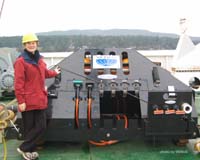
Venus at Victoria The Victoria Experimental Network Under the Sea (VENUS) facility, led by the University of Victoria, today opened the data portal to the seafloor through its information management and archive system. The portal-hosted on the new VENUS website gives scientists and the general public access to a constantly expanding "warehouse" of images, sounds and live data from the ocean floor. "This is a very important and exciting development providing a unique window for researchers and the public on the world under the sea, about which we have so much still to learn," says Dr. Martin Taylor, UVic's vice-president research. The $10.3-million VENUS facility offers the world's first interactive, real time portal to the ocean. Its underwater network of fibre optic cables and instruments, which is connected to the Internet, lets us all "enter" the ocean whenever we wish, and allows scientists to operate their instruments and download data online, day or night, in real time. The 3-km network of fibre optic cables and instruments that makes up the first leg of VENUS was installed in Saanich Inlet in February. Information has been streaming in since then. A second, 40-km leg will be installed in the Strait of Georgia near Vancouver later this year. At the heart of VENUS is a centralized data management and archive system that offers unrestricted access to long-term ocean observations. "It is a very advanced software 'structure' that was developed at UVic and sets new standards in data capture, access and delivery," says VENUS project director and marine biologist Dr. Verena Tunnicliffe. The four key features of the data management and archive system are: data acquisition and storage, easy user access to data, observatory monitoring, and the control of instruments by VENUS scientists. "This is a remarkable resource and represents a year of hard work by a 13-member team," says Tunnicliffe. "The information we see today on the VENUS website is just the tip of the iceberg," says Beno�t Pirenne, director of the database team. "Behind the scenes, there is an extensive software and hardware infrastructure designed to collect data from the various instruments and store them for 20 or more years." VENUS instruments collect several gigabytes of information every 24 hours. In its four-and-a-half months of operation, VENUS has already archived more than 35 million measurements and dozens of gigabytes of acoustic and visual data. That information-and new real time data-is now available to the world. The data management system is constantly evolving. In the near future, "software agents" will work on behalf of VENUS scientists, monitoring incoming data and alerting them by e-mail or cell phone if an unusual event or trend occurs that warrants immediate attention. Over its 20-year lifespan, VENUS will support studies on topics such as: long-term ocean change; tides, currents and mixing; fish and marine mammal movements; seafloor community ecology; underwater noise pollution; sediment and slope dynamics; and plankton behaviour. VENUS is funded by the Canada Foundation for Innovation, the British Columbia Knowledge Development Fund, and other contributions from federal agencies, industry and sponsors. Its data management and storage system is shared with the larger NEPTUNE Canada seafloor observatory project, also led by UVic. The University of Victoria is recognized internationally for its excellence in earth, ocean and climate systems research and education. With its unique location, rich marine environment, and proximity to other key marine research centres, UVic is taking a lead international role in ocean sciences and the development of marine technologies. Community Email This Article Comment On This Article Related Links the missing link Water News - Science, Technology and Politics
 Creating A Window On Oceans In Motion
 Halifax, Canada (SPX) Jun 25, 2006
Scientists and resource managers could soon have a highly detailed picture of marine conditions and the migrations of fish and ocean animals throughout the world, according to international experts convening a landmark conference in Canada June 27-30. |
|
|

| The content herein, unless otherwise known to be public domain, are Copyright 1995-2006 - SpaceDaily.AFP and UPI Wire Stories are copyright Agence France-Presse and United Press International. ESA PortalReports are copyright European Space Agency. All NASA sourced material is public domain. Additionalcopyrights may apply in whole or part to other bona fide parties. Advertising does not imply endorsement,agreement or approval of any opinions, statements or information provided by SpaceDaily on any Web page published or hosted by SpaceDaily. Privacy Statement |