|
 |
 |
 |
 |
 |
 |
 |
 |

 |
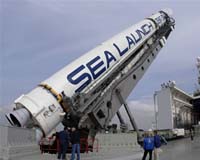
Sea Launch Operations To Be Resumed Despite Liftoff Failure
Washington DC (RIA Novosti) Jan 31, 2007 Russia's Federal Space Agency said Wednesday it hopes the Sea Launch project will be resumed despite the explosion of a Zenit-3SL rocket carrying a commercial communications satellite. "A split second following separation from the launch tower, an emergency occurred causing the Zenit-3SL booster rocket to fall back onto the floating platform and damaging it," press secretary Igor Panarin said. "We hope there will be no long-term consequences and that the Sea Launch program will be resumed." The rocket exploded during liftoff from an oceangoing platform in the Pacific early Wednesday (11:22 p.m. GMT Tuesday), a company spokeswoman said Wednesday. "There was an explosion as we were lifting off. No one involved in the launch was injured," Paula Korn said. She said a special commission has been set up to investigate the failed launch. The Boeing-developed NSS-8 satellite was meant for Netherlands-based SES New Skies. Established in 1995, the Sea Launch consortium is owned by Boeing, Kvaerner ASA of Oslo, Norway, and SDO Yuzhnoye/PO Yuzhmash of Dnepropetrovsk, Ukraine, and RSC-Energia of Moscow. The company launches its vehicles from the equator, which allows rockets to carry heavier payloads than they could from other locations due to the physics of the Earth's rotation. The Zenit-3SL rocket has three stages, all fueled by kerosene and liquid oxygen.
earlier related report "SES New Skies is currently not in a position to comment on the possible causes of the mission failure and is awaiting the results of the official investigation which is in the process of being installed. "NSS 8 was built by Boeing, with launch services from the Odyssey Platform in the equatorial Pacific provided by Sea Launch. The spacecraft was intended to operate at SES New Skies orbital position of 57 degrees East to replace the existing NSS 703 satellite. "The launch failure of NSS 8 means that NSS 703 will now stay at 57 degrees East in order to continue to serve existing customers until at least 2009. "SES New Skies has already initiated the construction of NSS 9 for launch in 2009 into the Pacific Ocean Region. NSS 9 is intended to free up NSS 5 which in turn will then be free to relocate to 57 degrees to replace NSS 703. "The NSS 8 launch failure is thus not expected to have an impact on existing customers or revenues."
earlier related report Sea Launch, the operator of the Zenit rocket, said no one was hurt. The extent of damage to the launch platform was not yet known. The commercial NSS 8 satellite, owned by SES New Skies of the Netherlands, was equipped with nearly 100 transponders for high-speed Internet, broadcasting and other services. California-based Sea Launch is a partnership of Boeing of the United States, Russia's RSC-Energia, Aker ASA of Norway and SDO Yuznoye/PO Yuzhmash of Ukraine. SES New Skies is a unit of European satellite giant SES Global. Yesterday's launch from the equator in the Pacific would have been Sea Launch's 24th flight since its debut in 1999. The company had one previous failure of its Zenit model when a mobile communications satellite was lost in March 2000 due to a valve problem in the rocket's second stage. SES New Skies said in a statement it was not prepared to comment on potential causes of the mission's failure and was waiting for the results of an investigation. The Zenit rocket was fully fueled with kerosene and liquid oxygen when it exploded. The launch was being broadcast on the Internet but the transmission was cut off as a fireball enveloped the platform, Spaceflightnow.com reported.
Source: RIA Novosti Source: Xinhua News Agency Community Email This Article Comment On This Article Related Links Launch Pad at Space-Travel.com Launch Pad at Space-Travel.com
 SpaceWorks Engineering Releases Study On Emerging Commercial Transport Services To ISS
 Atlanta GA (SPX) Jan 24, 2007
Engineering consulting firm SpaceWorks Engineering announces the release of a new space economic study entitled: "Winning in the Next Space Market: Prospects for Financial Success of Commercial Transportation Services to the International Space Station (ISS)." This is the first study of its kind which provides quantitative evidence that emerging space transportation companies can make a profit supporting the ISS and estimates the cost savings to the government of such outsourcing. |
|
|

| The content herein, unless otherwise known to be public domain, are Copyright 1995-2006 - SpaceDaily.AFP and UPI Wire Stories are copyright Agence France-Presse and United Press International. ESA PortalReports are copyright European Space Agency. All NASA sourced material is public domain. Additionalcopyrights may apply in whole or part to other bona fide parties. Advertising does not imply endorsement,agreement or approval of any opinions, statements or information provided by SpaceDaily on any Web page published or hosted by SpaceDaily. Privacy Statement |