|
 |
 |
 |
 |
 |
 |
 |
 |

 |
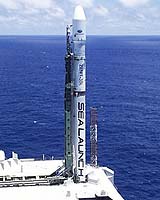
Sea Launch Lofts XXXXXXXXX
McLean VA (SPX) Feb 08, 2006 International Launch Services (ILS) announces three awards as it kicks off its participation this week in a satellite industry conference in Washington, D.C. "Right out of the chute, we announced awards from returning customers and had a fantastically successful Atlas V launch with NASA's New Horizons mission to Pluto - and there are 11 months to go in 2006," said Mark Albrecht, ILS president. A joint venture of Lockheed Martin of Bethesda, Md., and Khrunichev State Research and Production Space Center of Moscow, ILS markets and manages satellite launch missions on the American Atlas and Russian Proton vehicles. ILS could launch as many as nine satellites this year, Albrecht said, noting that only three weeks remain before the next ILS mission. That will be a Proton Breeze M launch for EADS Astrium with the ARABSAT 4A satellite, scheduled for Feb. 28/March 1. The first ILS mission was the New Horizons launch on Jan. 19, using the top-of-the-line Lockheed Martin Atlas V-551 configuration with 2.5 million pounds of thrust. The three Proton awards announced are the following: + Telesat will launch its Nimiq 4 satellite in 2008, for its fifth flight with ILS. + JSAT became the first Japanese operator to use a Russian vehicle when it scheduled its JCSAT-11 satellite on Proton for 2007. JSAT launched three previous satellites on Atlas vehicles. + Sirius Satellite Radio has purchased a spot for spacecraft launch prior to December 2010. Its three in-orbit satellites were all launched by Proton in 2000. Community Email This Article Comment On This Article Related Links International Launch Services Launch Pad at Space-Travel.com
 Russian Carrier Rocket To Orbit Japanese Satellite
 Moscow (RIA) Feb 06, 2006
One of the Asia-Pacific region's leading satellite operators has signed a contract to use a Russian launch vehicle for the first time to orbit a satellite that will enhance the performance of its existing orbital group. |
|
|

| The content herein, unless otherwise known to be public domain, are Copyright 1995-2006 - SpaceDaily.AFP and UPI Wire Stories are copyright Agence France-Presse and United Press International. ESA PortalReports are copyright European Space Agency. All NASA sourced material is public domain. Additionalcopyrights may apply in whole or part to other bona fide parties. Advertising does not imply endorsement,agreement or approval of any opinions, statements or information provided by SpaceDaily on any Web page published or hosted by SpaceDaily. Privacy Statement |