|
 |
 |
 |
 |
 |
 |
 |
 |

 |
Scripps Has The Ear Out For Nukes And Asteroids Alike
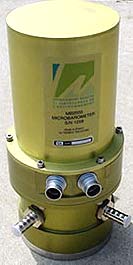
San Diego - August 22, 2001 A unique array of listening devices deployed by researchers at Scripps Institution of Oceanography at the University of California, San Diego, is one of the first stations in an important new global network that will detect signals from events as diverse as secret nuclear weapons tests, volcanic eruptions, and hurricanes in early formation. One of the first significant signals received by the Scripps instruments resulted from the April 23 explosion of a large meteor crashing into Earth's atmosphere. The meteor, reportedly 8- to 12-feet across, exploded with a yield of a several thousand tons of TNT. The Scripps array consists of eight microbarometers spread across two kilometers at the Cecil and Ida Green Pi�on Flat Observatory, located in the mountains south of Palm Springs, Calif. Each device is equipped with a noise reduction system that filters unwanted energy from atmospheric turbulence and increases sensitivity to signals at the "infrasonic" scale that fall below the 20 hertz level of human hearing. The array records signals that are too faint, and vary too slowly, to be detected by humans. The array is one of the first in a planned network of 60 that will play a vital role in efforts to monitor the globe for clandestine nuclear testing blasts. The infrasonic network tracks the atmosphere as part of a network that combines infrasonic signal tracking with seismic stations that pick up signals from the solid earth, hydroacoustic stations that monitor energy in the oceans, and a radionuclide network that checks the air for radioactive particles. "Infrasound energy tracking was big business in the 50s and 60s, when there was a lot of nuclear testing in the atmosphere," said Michael Hedlin, associate researcher at the Cecil H. and Ida M. Green Institute of Geophysics and Planetary Physics at Scripps, and, with Jon Berger, a lead scientist in the Pi�on Flat infrasound array development. "Interest in infrasound decreased when nuclear testing moved underground. Now infrasound monitoring has re-emerged in importance due to the number of countries that may be capable of developing nuclear weapons. We need to monitor around the globe." Hedlin says an infrasonic network is capable of providing data not only from nuclear blasts, but from a variety of natural phenomena that may become useful in scientific research. This was the case on April 23, when the large meteor crashed into the atmosphere over the Pacific Ocean several hundred miles west of Baja California. "If this rock had come into the atmosphere at a slightly different time, it might have exploded not over the Pacific, but over a large metropolitan area," said Hedlin. "With this global listening network we can develop much better statistics on large meteors and get a better idea of how often these massive objects enter the atmosphere." Large explosions send part of their acoustic energy into the audible range, but those signals dissipate rapidly. They also emit large amounts of energy into the infrasonic range in signals that decay slowly across vast distances. Thus the April 23 explosion was prominently featured 1,800 kilometers away on the Pi�on Flat instruments. The signals were also recorded approximately 11,000 kilometers away by an infrasound array in Germany. In addition to meteors, infrasonic energy is generated by chemical explosions, supersonic aircraft, tornadoes, landslides, earthquakes, and volcanoes. "Our colleagues in Japan have learned that minor volcanic eruptions of magma or gas might be missed seismically but produce strong acoustic signals," said Hedlin. "Seismic and infrasound data taken together give a much fuller account of activity inside the volcano that might be indicative of an impending, significant eruption." A new infrasonic array is set to be deployed in Cape Verde, a location off the coast of Africa known as a nursery for brewing hurricanes. As the hurricanes develop and emit infrasonic signals, Hedlin believes such data might contribute to early detection. "There is a lot going on in the atmosphere that we need to know more about. The infrasound network will offer us an unprecedented opportunity to better understand these phenomena on a global scale. "We anticipate that this global network of listening posts that monitors Earth's fluid exterior shell where we live will some day become as indispensable as the global seismic network that monitors the Earth's solid interior for seismic activity." Although the Scripps group provided the closest observations of the meteor, the event was analyzed by a consortium of universities and laboratories. The explosion was first noticed by a group at Los Alamos National Laboratory. Early characterization of the event was done by the Los Alamos group, the Center for Monitoring Research, the University of Hawaii, and the University of Alaska. The consortium is led by Henry Bass at the University of Mississippi. Construction of the array was supported by the Defense Threat Reduction Agency (DTRA), the Provisional Technical Secretariat (PTS) of the UN Comprehensive Test Ban Treaty Office in Vienna, and the US Army Space and Missile Defense Command (SMDC) University Research Initiative (URI). CommunityEmail This Article Comment On This Article Related Links Scripps Institution of Oceanography SpaceDaily Search SpaceDaily Subscribe To SpaceDaily Express Dirt, rocks and all the stuff we stand on firmly
 Magnetic Reconnection Region Larger Than 2.5 Million Km Found In The Solar Wind
 Paris (ESA) Jan 12, 2006
Using the ESA Cluster spacecraft and the NASA Wind and ACE satellites, a team of American and European scientists have discovered the largest jets of particles created between the Earth and the Sun by magnetic reconnection. This result makes the cover of this week's issue of Nature. |
|
|

|
|
|
|
|
|
|
|
|
|
|
|
| The content herein, unless otherwise known to be public domain, are Copyright 1995-2006 - SpaceDaily.AFP and UPI Wire Stories are copyright Agence France-Presse and United Press International. ESA PortalReports are copyright European Space Agency. All NASA sourced material is public domain. Additionalcopyrights may apply in whole or part to other bona fide parties. Advertising does not imply endorsement,agreement or approval of any opinions, statements or information provided by SpaceDaily on any Web page published or hosted by SpaceDaily. Privacy Statement |