
 |
 |
 |
 |
 |
 |
 |
 |
 |

 |
Scientists to discuss climate risk posed by wetlands destruction
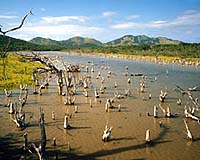
Sao Paulo (AFP) July 20, 2008 Moves around the world to drain marshes and other wetlands to make space for farming could be hastening climate change, scientists gathering in Brazil from Monday will be hearing. Around 700 researchers from around the world are to descend on the central western town of Cuiaba for a four-day conference to discuss ways to preserve wetlands, the UN University, a grouping of scholars, said in a statement. They are concerned that evaporation from warmer global temperatures and man's destruction of wetlands are releasing massive amounts of carbon into the atmosphere, which could be increasing greenhouse gases. Wetlands such as marshes, swamps, mangroves, peat bogs and river floodplains cover six percent of the Earth's land surface, and store up to 20 percent of terrestrial carbon in the form of slowly decaying organic matter, the statement said. They are estimated to contain 771 billion tons of greenhouses gases -- carbon dioxide and methane -- an amount comparable to the carbon content already in the atmosphere. According to the UN University, 60 percent of wetlands around the world have been destroyed in the past century, mainly to provide drainage for farming. "Too often in the past, people have unwittingly considered wetlands to be problems in need of a solution. Yet wetlands are essential to the planet's health," said UN Under Secretary-General Konrad Osterwalder, who is also rector of the UN University. A German expert, professor Wolfgang Junk of the Max Planck Institute for Evolutionary Biology, added: "Wetlands act as sponges and their role as sources, reservoirs and regulators of water is largely underappreciated by many farmers and others who rely on steady water supplies." The conference, co-organized with Brazil's Federal University of Mato Grosso in Cuiaba, will be looking at ways to protect and better manage wetlands, some of which extend over national borders. Cuiaba itself is on the edge of the Pantanal, a remote and therefore relatively untouched wetland straddling Brazil, Bolivia and Paraguay. The UN University is a community of researchers studying pressing global problems set up by the UN General Assembly. Its headquarters is in Japan. Community Email This Article Comment On This Article Share This Article With Planet Earth
Related Links Forestry News - Global and Local News, Science and Application
 Scattered Woodlands Complicate Forest's Response To Climate Change
 Madison WI (SPX) Jul 18, 2008
If a warmer Wisconsin climate causes some northern tree species to disappear in the future, it's easy to imagine that southern species will just expand their range northward as soon as the conditions suit them. |
|
|

| The content herein, unless otherwise known to be public domain, are Copyright 1995-2007 - SpaceDaily.AFP and UPI Wire Stories are copyright Agence France-Presse and United Press International. ESA Portal Reports are copyright European Space Agency. All NASA sourced material is public domain. Additional copyrights may apply in whole or part to other bona fide parties. Advertising does not imply endorsement,agreement or approval of any opinions, statements or information provided by SpaceDaily on any Web page published or hosted by SpaceDaily. Privacy Statement |
 del.icio.us
 Digg
Digg Reddit
 YahooMyWeb
 Google
 Facebook