|
 |
 |
 |
 |
 |
 |
 |
 |

 |
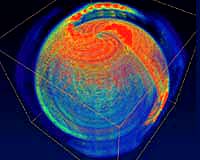
Scientists Visualize Waves In Space Caused By Mergers Of Black Holes
University Park - Jul 26, 2002 Merging black holes will rock the fabric of space and time with gravitational waves that start quiet, grow to a thunderous roar at the moment of impact, and then resonate from the final gong, according to international team of scientists who have created a novel computer model of such a merger based on Einstein's equations. The scientists presented the model at the Fourth International LISA Symposium on gravitational radiation at Penn State University in University Park. Gravitational waves constitute a form of radiation predicted by Einstein but which has yet to be directly detected. "The collision of two black holes is the ultimate manifestation of Einstein's theory of general relativity," said Lee Samuel Finn, Director of the Center for Gravitational Wave Physics at Penn State and chair of the LISA Symposium Scientific Organizing Committee. "Anything we can do to understand that process better is a step toward the success of the LISA mission." "We can only observe black holes plunging into each other through gravitational waves," said John Baker of NASA Goddard Space Flight Center in Greenbelt, Maryland. "This model is an important first step toward understanding what such waves will look -- or sound -- like." Baker and his colleagues, Manuela Campanelli and Carlos Lousto of the University of Texas at Brownsville, and Ryoji Takahashi of the Theoretical Astrophysics Center in Copenhagen, collectively known as the Lazarus Team, have recently published a journal article about this modeling in the journal Physical Review D. Baker presents his novel computer model during the LISA meeting this week. Gravitational waves ripple through space like waves upon an ocean. These exotic waves offer an entirely new window on the Universe and may carry direct information about black holes and stellar explosions, or information about the Big Bang itself. Gravitational waves are produced by massive objects in motion. The waves travel at light speed with a wide range of frequencies, carrying energy away from the source. Unlike light waves (electromagnetic radiation), gravitational waves do not interact strongly with matter. Passing gravitational waves alter the distance between objects, gently shifting them so they bob like buoys rising and falling on the sea surface with each passing wave. Even for objects as far apart as the Earth and the Moon though, gravitational waves might alter their separation only by a length a thousand times smaller than an atom. The Laser Interferometer Gravitational-Wave Observatory (LIGO) in Washington and Louisiana -- funded by the National Science Foundation and now in the commissioning phase -- hopes to detect distances between test objects altered by gravitational waves. A proposed NASA-European Space Agency mission called the Laser Interferometer Space Antenna (LISA) would do the same from space. But these observatories need models in order to interpret the data they hope to collect. "These calculations are the first to give us some insight into certain kinds of signals that we'll be receiving with LISA," said Robin Stebbins, the NASA Project Scientist for LISA. "Since gravitational waves produce such tiny effects, even in the best receivers we know how to build, any knowledge of this complex phenomenon is very valuable. Now that the Lazarus team is able to model the expected signals, we can better optimize the detectors." Events that produce detectable gravitational waves include black-hole and galaxy mergers, neutron-star mergers, and massive-star explosions. The Lazarus team focused on binary black holes in their final orbit, just as they are about to merge. This model also includes galaxy mergers -- the coalescence of supermassive black holes in galaxy cores. This latest computer model uses a combination of treatments, each specialized to a different stage in the process of binary-black-hole coalescence. Most importantly, the model employs Einstein's nonlinear equations to describe the critical moment when the black holes plunge together, requiring a supercomputer with at least 100 gigabytes of RAM. Simple Newtonian theory does not account for the warping of spacetime by gravity, a prediction of General Relativity, and is thus inadequate for describing the physics of strong gravity near a black hole. The model supports previous predictions that the gravitational waves from coalescing black holes will be relatively weak until just moments before the merger. Then, the wave would grow louder, culminating in a thunderous impact. After this, the newly formed single black hole would resonate with that final gong from the merger. Stellar-size black holes would produce waves with a frequency of about 10 hertz, in the range of the ground-based LIGO detector. Supermassive black holes would produce waves with a frequency of a thousandth of a hertz, in the range of the space-based LISA detector. This work began while all the collaborators were working at the Max Planck Institute for Gravitational Physics in Germany. The institute's director, Bernard Schutz, who is a European member of the LISA International Science Team, commented that this study "... is a perfect illustration of the international nature of work in gravitational waves and the interpretation of Einstein's theory. "From detector development to the prediction and interpretation of observations, we need to involve the best scientific minds from around the world if we are to do justice to Einstein's great vision." Community Email This Article Comment On This Article Related Links Modeling Gravitational Radiation from Coalescing Binary Lazarus Web Site SpaceDaily Search SpaceDaily Subscribe To SpaceDaily Express Black Hole Science and News
 MIT: SpInning Black Hole Leaves Dent In Space-Time
 Boston MA (SPX) Jan 12, 2006
MIT scientists and colleagues have found a black hole that has chiseled a remarkably stable indentation in the fabric of space and time, like a dimple in one's favorite spot on the sofa. |
|
|

| The content herein, unless otherwise known to be public domain, are Copyright 1995-2006 - SpaceDaily.AFP and UPI Wire Stories are copyright Agence France-Presse and United Press International. ESA PortalReports are copyright European Space Agency. All NASA sourced material is public domain. Additionalcopyrights may apply in whole or part to other bona fide parties. Advertising does not imply endorsement,agreement or approval of any opinions, statements or information provided by SpaceDaily on any Web page published or hosted by SpaceDaily. Privacy Statement |