|
 |
 |
 |
 |
 |
 |
 |
 |

 |
Scientists Test Unmanned Aerial Systems Refueling
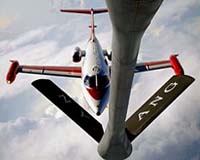
Wright-Patterson AFB OH (AFNS) Sep 19, 2006 Air Force Research Laboratory Air Vehicles Directorate scientists completed flight tests Aug. 31 on the first autonomous aircraft in the refueling position, which successfully engaged during each of the 15 flights. The Automated Aerial Refueling Station Keeping Flight Test demonstrated the capability to perform boom and receptacle refueling of unmanned air vehicle systems behind a KC-135 tanker using operationally representative subsystems. "The Station Keeping flight tests were a major step forward for automated aerial refueling technology," said Jake Hinchman, Air Force Research Laboratory automated aerial refueling program manager. "The next step for the program is to mature the technology into an operational capability." The test integrates components on both the tanker and receiver aircraft to demonstrate the ability for the receiver aircraft to autonomously hold position relative to the tanker while the tanker executes its standard maneuvers. During the Aug. 15 flight, at the contact position where Air Force aircraft could start receiving fuel from the tanker, the learjet's automated aerial refueling flight control system was engaged enabling the aircraft to autonomously hold the contact position while the tanker executed both straight and level flight and turns. During the flight, the automated aerial refueling system was engaged at the contact position for 23 consecutive minutes, allowing the learjet to follow the KC-135 through two full orbits. "The benefits of unmanned aerial system refueling are numerous," said Hinchmen. "We fully expect an increase in combat radius, increase in mission time, reduction of response time for time-critical targets, and a reduced need for forward staging areas. An increase of in-theater presence is another advantage." Over the next year, the automated aerial refueling team will build upon the success of this flight test towards enabling new automated refueling capabilities. Within the next year, the team will demonstrate autonomous maneuvering around the tanker. The learjet will engage the automated aerial refueling system at the observation position on the tanker wing and be directed from a control station to go to the pre-contact and contact positions upon approval from the tanker crew. This test will be combined with simulations of both multi-ship operations around the tanker and long distance tanker rendezvous to demonstrate that the automated aerial refueling capability is ready for transition from the Learjet testbed to Air Force assets. Community Email This Article Comment On This Article Related Links US Air Force Research Laboratory Air Vehicles Directorate UAV Technology at SpaceWar.com UAV News - Suppliers and Technology
 Reaper Moniker Given To MQ-9 Unmanned Aerial Vehicle
 Washington DC (SPX) Sep 19, 2006
The Air Force Chief of Staff announced "Reaper" has been chosen as the name for the MQ-9 unmanned aerial vehicle. The Air Force is the Department of Defense's executive agent for designating and naming military aerospace vehicles. In the case of the Reaper, Gen. T. Michael Moseley made the final decision after an extensive nomination and review process, coordinated with the other services. |
|
|

| The content herein, unless otherwise known to be public domain, are Copyright 1995-2006 - SpaceDaily.AFP and UPI Wire Stories are copyright Agence France-Presse and United Press International. ESA PortalReports are copyright European Space Agency. All NASA sourced material is public domain. Additionalcopyrights may apply in whole or part to other bona fide parties. Advertising does not imply endorsement,agreement or approval of any opinions, statements or information provided by SpaceDaily on any Web page published or hosted by SpaceDaily. Privacy Statement |