|
 |
 |
 |
 |
 |
 |
 |
 |

 |
Scientists Studying Desert Air To Uunderstand Weather And Climate
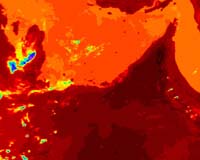
United Arab Emirates (SPX) Aug 19, 2004 NASA, Naval Research Laboratory (NRL) and Scripps Institution of Oceanography scientists have assembled in the Arabian Desert to study tiny airborne particles called aerosols and their effect on weather and climate. The scientists are collaborating with researchers from the United Arab Emirates Department of Water Resources Studies and 20 other U.S., European and South African research laboratories to decipher the complex processes controlling the area's climate. The United Arab Emirates Unified Aerosol Experiment (UAE2) mission runs from August 5 through September 30. Scientists are using satellites, computer models and ground stations to understand the unique "mixing bowl" of desert dust, smoke and other aerosols created by the complex atmospheric circulations. "The combination of man-made emissions, smoke from the Indian subcontinent and desert dust combine in the air to make a unique aerosol laboratory," said Hal Maring of NASA Headquarters, Washington. "We have the most intensely monitored remote-sensing aerosol network ever assembled, including two radiation and aerosol super sites, 10 satellite instruments, six computer models, a research aircraft and a research vessel," said Jeff Reid, mission scientist from NRL in Monterey, Calif. "There are 70 scientists participating, 40 of them working in the field, from over a dozen institutions, including the large South African and Colorado-based National Center for Atmospheric Research (NCAR) weather modification teams," he added. Aerosols have always been an interesting puzzle piece in learning how climate works. Lighter aerosols reflect heat and sunlight and have cooling properties. Darker aerosols absorb heat and light, warming the atmosphere. UAE2's mission will measure aerosol properties, where aerosols move, and whether they add or remove warmth. Scientists also hope to model and explain complicated weather patterns in the coastal regions of the Arabian Gulf and the Gulf of Oman. By obtaining more accurate data about aerosols and their behavior, scientists will improve computer climate models and predictions of climate behavior in response to changes in aerosol concentrations. To accomplish this task, NASA will start from space, using primarily its Terra and Aqua satellites, but other satellites as well. These satellite data will be compared to ground-based remote sensing measurements of mineral dust and pollutant aerosols gathered by 15 Aerosol Robotic Network instruments over land and water, NRL's Mobile Atmospheric Aerosol and Radiation Characterization Observatory (MAARCO) and NASA's Surface-sensing Measurements for Atmospheric Radiative Transfer. Navy researchers will use the aircraft, MAARCO and satellite data to evaluate the Navy's global and regional weather and aerosol-transport computer models. The Arabian Gulf region presents a challenge to meteorologists trying to simulate weather with computer models, because sea-surface and land temperatures vary to extremes and the topography varies dramatically. There are also strong small to medium-sized weather changes ranging from one storm cloud to a large cluster of thunderstorms the size of Connecticut. Using MAARCO, scientists from the Scripps Institution of Oceanography and Poland's Warsaw University will study the impact of aerosols and clouds on incoming solar radiation and the hydrologic cycle and energy balance in this mostly rain-free area. "This project will complement Scripps' effort to understand climate change in this region of the world," said Piotr Flatau, a research scientist at Scripps, who will be working with Krzysztof Markowicz and others from Warsaw University during the project. "I know the Arabian Sea from research cruises during the Indian Ocean Experiment (INDOEX), but the UAE2 experiment brings a new set of challenges. While INDOEX took place in a mostly monsoonal region, the UAE is dry and hot," continued Flatau. The temperatures are reaching 40 degrees Celsius (104� F) there right now and we do not expect much rain," Flatau said. "The UAE Office of His Highness the President, Department of Water Resource Studies (DWRS), is providing extensive logistical support, including access to five weather radars and 50 surface stations," said Lt. Col. Mangoosh, Office of the President of the United Arab Emirates. Community Email This Article Comment On This Article Related Links UAE2 Mission Aerosol RoboticNetwork UAE Department of Water Resources Studies SpaceDaily Search SpaceDaily Subscribe To SpaceDaily Express Earth Observation News - Suppiliers, Technology and Application
 New Legislation Initiated To Support Commercial Remote Sensing Industry
 New York NY (SPX) Jan 11, 2006
The importance of remotely sensed data and technologies to support natural disasters has prompted attention and action in Washington. New initiatives and legislation authorizing appropriations to the remote sensing industry will be discussed at Strategic Research Institute's U.S. Commercial Remote Sensing Industry conference, scheduled for February 9-10, 2006 in Washington D.C. |
|
|

| The content herein, unless otherwise known to be public domain, are Copyright 1995-2006 - SpaceDaily.AFP and UPI Wire Stories are copyright Agence France-Presse and United Press International. ESA PortalReports are copyright European Space Agency. All NASA sourced material is public domain. Additionalcopyrights may apply in whole or part to other bona fide parties. Advertising does not imply endorsement,agreement or approval of any opinions, statements or information provided by SpaceDaily on any Web page published or hosted by SpaceDaily. Privacy Statement |