|
 |
 |
 |
 |
 |
 |
 |
 |

 |
Scientists Study Pioneer Anomalies
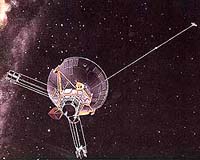
Los Alamos (UPI) Aug 17, 2006 U.S. scientists say mysterious changes in acceleration seen in NASA's Pioneer 10 and 11 space probes might point toward new ideas in physics. During the 1980s, NASA researchers noticed the Pioneer 11 spacecraft was slowing more quickly than expected as it neared the edge of the solar system. A similar effect occurred with the Pioneer 10 spacecraft, which was sent in the opposite direction. Finally, in 1998, John Anderson, then at the Jet Propulsion Laboratory in Pasadena, Calif., and colleagues made their findings public. Since then, other NASA and European Space Agency probes have also exhibited unexplained changes in speed. Anderson, now with the Global Aerospace Corp., says although it's possible an overlooked effect from ordinary physics might account for the anomalies, something more exotic could also be involved. For example, the spacecraft trajectories could be influenced by the presence of dark matter in the solar system, says Michael Nieto of the Los Alamos National Laboratory. Or maybe the laws of gravity need reworking. "We're just throwing it out as a possibility that the anomalies might have a single cause," said Anderson. "We thought it was really time to get the community thinking about it."
Source: United Press International Community Email This Article Comment On This Article Related Links Beyond Sol Space Tourism, Space Transport and Space Exploration News
 Voyager 1 Hits 100 AU Marker Nearly 14 Hours Out
 Pasadena CA (SPX) Aug 16, 2006
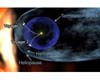
Voyager 1, already the most distant human-made object in the cosmos, reaches 100 astronomical units from the sun on Tuesday, August 15 at 5:13 p.m. Eastern time (2:13 p.m. Pacific time). That means the spacecraft, which launched nearly three decades ago, will be 100 times more distant from the sun than Earth is. |
|
|

| The content herein, unless otherwise known to be public domain, are Copyright 1995-2006 - SpaceDaily.AFP and UPI Wire Stories are copyright Agence France-Presse and United Press International. ESA PortalReports are copyright European Space Agency. All NASA sourced material is public domain. Additionalcopyrights may apply in whole or part to other bona fide parties. Advertising does not imply endorsement,agreement or approval of any opinions, statements or information provided by SpaceDaily on any Web page published or hosted by SpaceDaily. Privacy Statement |