|
 |
 |
 |
 |
 |
 |
 |
 |

 |
Scientists Solve Mystery Of Meteor Crater's Missing Melted Rocks
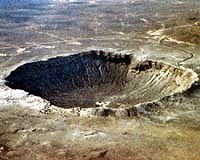
Tucson AZ (SPX) Mar 10, 2005 Scientists have discovered why there isn't much impact-melted rock at Meteor Crater in northern Arizona. The iron meteorite that blasted out Meteor Crater almost 50,000 years ago was traveling much slower than has been assumed, University of Arizona Regents' Professor H. Jay Melosh and Gareth Collins of the Imperial College London report in the cover article of Nature (March 10). "Meteor Crater was the first terrestrial crater identified as a meteorite impact scar, and it's probably the most studied impact crater on Earth," Melosh said. "We were astonished to discover something entirely unexpected about how it formed." The meteorite smashed into the Colorado Plateau 40 miles east of where Flagstaff and 20 miles west of where Winslow have since been built, excavating a pit 570 feet deep and 4,100 feet across � enough room for 20 football fields. Previous research supposed that the meteorite hit the surface at a velocity between about 34,000 mph and 44, 000 mph (15 km/sec and 20 km/sec). Melosh and Collins used their sophisticated mathematical models in analyzing how the meteorite would have broken up and decelerated as it plummeted down through the atmosphere. About half of the original 300,000 ton, 130-foot-diameter (40-meter-diameter) space rock would have fractured into pieces before it hit the ground, Melosh said. The other half would have remained intact and hit at about 26,800 mph (12 km/sec), he said. That velocity is almost four times faster than NASA's experimental X-43A scramjet - the fastest aircraft flown - and ten times faster than a bullet fired from the highest-velocity rifle, a 0.220 Swift cartridge rifle. But it's too slow to have melted much of the white Coconino formation in northern Arizona, solving a mystery that's stumped researchers for years. Scientists have tried to explain why there's not more melted rock at the crater by theorizing that water in the target rocks vaporized on impact, dispersing the melted rock into tiny droplets in the process. Or they've theorized that carbonates in the target rock exploded, vaporizing into carbon dioxide. "If the consequences of atmospheric entry are properly taken into account, there is no melt discrepancy at all," the authors wrote in Nature. "Earth's atmosphere is an effective but selective screen that prevents smaller meteoroids from hitting Earth's surface," Melosh said. When a meteorite hits the atmosphere, the pressure is like hitting a wall. Even strong iron meteorites, not just weaker stony meteorites, are affected. "Even though iron is very strong, the meteorite had probably been cracked from collisions in space," Melosh said. "The weakened pieces began to come apart and shower down from about eight-and-a-half miles (14 km) high. And as they came apart, atmospheric drag slowed them down, increasing the forces that crushed them so that they crumbled and slowed more." Melosh noted that mining engineer Daniel M. Barringer (1860-1929), for whom Meteor Crater is named, mapped chunks of the iron space rock weighing between a pound and a thousand pounds in a 6-mile-diameter circle around the crater. Those treasures have long since been hauled off and stashed in museums or private collections. But Melosh has a copy of the obscure paper and map that Barringer presented to the National Academy of Sciences in 1909. At about 3 miles (5 km) altitude, most of the mass of the meteorite was spread in a pancake shaped debris cloud roughly 650 feet (200 meters) across. The fragments released a total 6.5 megatons of energy between 9 miles (15 km) altitude and the surface, Melosh said, most of it in an airblast near the surface, much like the tree-flattening airblast created by a meteorite at Tunguska, Siberia, in 1908. The intact half of the Meteor Crater meteorite exploded with at least 2.5 megatons of energy on impact, or the equivalent of 2.5 tons of TNT. Elisabetta Pierazzo and Natasha Artemieva of the Planetary Science Institute in Tucson, Ariz., have independently modeled the Meteor Crater impact using Artemieva's Separated Fragment model. They find impact velocities similar to that which Melosh and Collins propose. Melosh and Collins began analyzing the Meteor Crater impact after running the numbers in their Web-based "impact effects" calculator, an online program they developed for the general public. The program tells users how an asteroid or comet collision will affect a particular location on Earth by calculating several environmental consequences of the impact. Community Email This Article Comment On This Article Related Links University of Arizona SpaceDaily Search SpaceDaily Subscribe To SpaceDaily Express Asteroid and Comet Mission News, Science and Technology
 NASA'S Spitzer Finds Possible Comet Dust Around Dead Star
 Pasadena CA (SPX) Jan 12, 2006
NASA's Spitzer Space Telescope has spotted what may be comet dust sprinkled around the white dwarf star G29-38, which died approximately 500 million years ago. |
|
|

| The content herein, unless otherwise known to be public domain, are Copyright 1995-2006 - SpaceDaily.AFP and UPI Wire Stories are copyright Agence France-Presse and United Press International. ESA PortalReports are copyright European Space Agency. All NASA sourced material is public domain. Additionalcopyrights may apply in whole or part to other bona fide parties. Advertising does not imply endorsement,agreement or approval of any opinions, statements or information provided by SpaceDaily on any Web page published or hosted by SpaceDaily. Privacy Statement |