|
 |
 |
 |
 |
 |
 |
 |
 |

 |
Scientists Solve Cosmological Puzzle
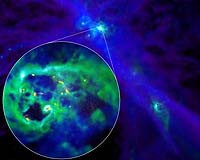
Hamilton, Canada (SPX) Nov 30, 2007 Researchers using supercomputer simulations have exposed a very violent and critical relationship between interstellar gas and dark matter when galaxies are born - one that has been largely ignored by the current model of how the universe evolved. The findings, published today in Science, solve a longstanding problem of the widely accepted model - Cold Dark Matter cosmology - which suggests there is much more dark matter in the central regions of galaxies than actual scientific observations suggest. "This standard model has been hugely successful on the largest of scales-those above a few million light-years-but suffers from several persistent difficulties in predicting the internal properties of galaxies," says Sergey Mashchenko, research associate in the Department of Physics and Astronomy at McMaster University. "One of the most troublesome issues concerns the mysterious dark matter that dominates the mass of most galaxies." Supercomputer cosmological simulations prove that indeed, this problem can be resolved. Researchers modeled the formation of a dwarf galaxy to illustrate the very violent processes galaxies suffer at their births, a process in which dense gas clouds in the galaxy form massive stars, which, at the ends of their lives, blow up as supernovae. "These huge explosions push the interstellar gas clouds back and forth in the centre of the galaxy," says Mashchenko, the lead author of the study. "Our high-resolution model did extremely accurate simulations, showing that this 'sloshing' effect - similar to water in a bathtub- kicks most of the dark matter out of the centre of the galaxy." Cosmologists have largely discounted the role interstellar gas has played in the formation of galaxies and this new research, says Mashchenko, will force scientists to think in new terms and could lead to a better understanding of dark matter. The simulations reported in the research paper were carried out on the Shared Hierarchical Academic Research Computing Network (SHARCNET). Community Email This Article Comment On This Article Related Links McMaster University Stellar Chemistry, The Universe And All Within It
 NASA's GLAST Satellite Arrives At Naval Research Lab For Testing
 Greenbelt MD (SPX) Nov 30, 2007
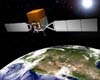
NASA's Gamma-ray Large Area Space Telescope (GLAST) has arrived at the Naval Research Laboratory (NRL) in Washington for its final round of testing. The GLAST spacecraft has successfully completed two of its three environmental tests at the prime contractor, General Dynamics Advanced Information Systems in Gilbert, Ariz. These tests included exposure to extreme vibrations and electromagnetic fields. |
|
|

| The content herein, unless otherwise known to be public domain, are Copyright 1995-2007 - SpaceDaily.AFP and UPI Wire Stories are copyright Agence France-Presse and United Press International. ESA Portal Reports are copyright European Space Agency. All NASA sourced material is public domain. Additional copyrights may apply in whole or part to other bona fide parties. Advertising does not imply endorsement,agreement or approval of any opinions, statements or information provided by SpaceDaily on any Web page published or hosted by SpaceDaily. Privacy Statement |