|
 |
 |
 |
 |
 |
 |
 |
 |

 |
Scientists Report Increased Thinning Of West Antarctic Glaciers
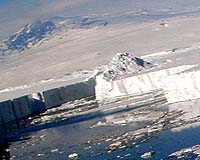
Wallops Island VA (SPX) Sep 24, 2004 Glaciers in West Antarctica are shrinking at a rate substantially higher than observed in the 1990s. They are losing 60 percent more ice into the Amundsen Sea than they accumulate from inland snowfall. The study was conducted by a science team from NASA, U.S. universities and from the Centro de Estudios Cientificos in Chile. It is based on satellite data and comprehensive measurements made in 2002 by a science team aboard a Chilean P-3 aircraft equipped with NASA sensors. Science Express published the findings today. The ice loss from the measured glaciers corresponds to an annual sea-level rise of .008 inches (.2 millimeters) or more than 10 percent of the total global increase of about .07 inches (1.8 millimeters) per year. For a balanced glacial system, the amount of glacier ice melting or flowing into the sea roughly equals the ice formed from snow accumulations further inland. The scientists report the Amundsen Sea glaciers are not in balance. Bob Thomas, a science team member with EG&G Services at the NASA Goddard Space Flight Center's Wallops Flight Facility, Wallops Island, Va., commented that as the glaciers flow to the ocean, they become afloat to form ice shelves. "The ice shelves act like a cork and slow down the flow of the glacier," Thomas said. "Ice shelves in the Amundsen Sea appear to be thinning, offering less resistance to their tributary glaciers. Our measurements show an increase in glacier thinning rates that affects not only the mouth of the glacier, but also 60 miles (100 kilometers) to 190 miles (300 kilometers) inland," Thomas said. The scientists noted the earth underneath the ice is further below sea level than had been assumed, so the ice is thicker than once thought. "This increases the amount of ice each glacier can discharge into the ocean as its speed increases. It makes it easier for the thinning glacier to float free from its bed, and thus further 'loosen the cork'," Thomas said. Thomas pointed out the observed increases in velocities and thinning rates apply to only a short time period, so it is too early to tell if the accelerated thinning is part of a natural cycle or is a sign of a longer-term change. "Continued observation is important," he said. "The rates of glacier change remain relatively small at present," said Eric Rignot, a study participant from NASA's Jet Propulsion Laboratory, Pasadena, Calif. "But the potential exists for these glaciers to increase global sea level by more than one meter. The time scale over which this will take place depends on how much faster the glaciers can flow, which we do not know at present," he said. Thomas said in the last 10 years the ability to accurately measure glaciers worldwide has greatly improved. Measurements from aircraft and satellites like NASA's Ice, Cloud and Land Elevation Satellite (ICESat), launched in 2003, have greatly improved accuracy. Community Email This Article Comment On This Article Related Links Centro de Estudios Cientificos SpaceDaily Search SpaceDaily Subscribe To SpaceDaily Express Nuclear Space Technology at Space-Travel.com
 Rewriting Glacial History In Pacific North America
 Edmonton AB (SPX) Jan 10, 2006
Although the story on glacier fluctuations in northwestern North America over the last 10,000 years has remained largely unchanged for decades, new evidence discovered by a University of Alberta researcher will rewrite that glacial history and offer clues about our climate history during the last several thousand years. |
|
|

| The content herein, unless otherwise known to be public domain, are Copyright 1995-2006 - SpaceDaily.AFP and UPI Wire Stories are copyright Agence France-Presse and United Press International. ESA PortalReports are copyright European Space Agency. All NASA sourced material is public domain. Additionalcopyrights may apply in whole or part to other bona fide parties. Advertising does not imply endorsement,agreement or approval of any opinions, statements or information provided by SpaceDaily on any Web page published or hosted by SpaceDaily. Privacy Statement |