|
 |
 |
 |
 |
 |
 |
 |
 |

 |
Scientists Precisely Track Short Term Earth Wobbles
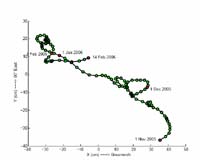
Washington DC (SPX) Jun 27, 2006 New technologies are enabling scientists to determine the extent and causes of Earth's short-term wobbling with extreme precision. Like a spinning top, Earth wobbles as it rotates on its axis. In fact, it displays many different wobbling motions, ranging in period from a few minutes to billions of years. Some of these are well studied, such as the Chandler wobble of 433 days and the annual wobble, which together can tilt Earth's axis up to 10 meters (32 feet) from its nominal center. Earth's irregular, shorter term wobbles, lasting a week or so, have been more difficult to study, partly because these motions are usually masked by those of more prominent wobbles. Now, scientists in Belgium and France have taken advantage of a quirk in the pattern of large-scale motions and the advent of the Global Positioning System to pin down short-term wobbles that occurred from November 2005 through February 2006. During this period, the Chandler wobble and the annual wobble essentially cancelled each other out, an event that occurs every 6.4 years, allowing the researchers to focus on the short-period wobbles. Over these three and a half months, the pole position traced small loops, ranging in size from that of a standard sheet of paper - at 8-1/2 by 11 inches - down to that of a cell phone, and it remained within a one meter square during the four months. Sebastien Lambert, of the Royal Observatory of Belgium, and colleagues both there and at the Paris Observatory took advantage of the opportunity to track short-term wobbles, using newly available GPS data that establish the location of the poles precisely. They then sought to determine why these motions occurred when they did. In a paper scheduled to be published 1 July in Geophysical Research Letters, they conclude that weather patterns in the northern hemisphere played a significant role. Both the location of high- or low-pressure centers - for example, over Asia or northern Europe - and the relationship of these weather systems to each other played a measurable role in creating, or exciting, small, short-term wobbles, the team reported. The ocean also affects short-term wobbles, according to Lambert and his colleagues. They were able to correlate oceanic and atmospheric pressure variations with the small observed wobbles during the study period. Though these forces had been credited by previous researchers with maintaining the large Chandler wobble, this was the first time that scientists have been able to demonstrate that day-to-day changes in atmospheric pressure produce a measurable effect on Earth's rotation. The study was funded by the Belgian Science Policy Office, the Royal Observatory of Belgium, and the Paris Observatory. Community Email This Article Comment On This Article Related Links AGU GPS Applications, Technology and Suppliers
 Baltimore City Public School Buses and Pupils Made Safer With GPS System
 Torrance CA (SPX) Jun 26, 2006
Radio Satellite Integrators Inc. announced it has been contracted by the Baltimore City Public School System and is currently installing a turn-key automatic-vehicle-location system for their school bus fleet. |
|
|

| The content herein, unless otherwise known to be public domain, are Copyright 1995-2006 - SpaceDaily.AFP and UPI Wire Stories are copyright Agence France-Presse and United Press International. ESA PortalReports are copyright European Space Agency. All NASA sourced material is public domain. Additionalcopyrights may apply in whole or part to other bona fide parties. Advertising does not imply endorsement,agreement or approval of any opinions, statements or information provided by SpaceDaily on any Web page published or hosted by SpaceDaily. Privacy Statement |