|
 |
 |
 |
 |
 |
 |
 |
 |

 |
Scientists Observe Light Fighting To Escape Black Hole's Pull
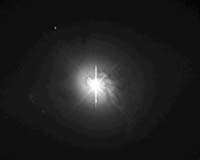
Greenbelt - Jun 27, 2002 Scientists have found new evidence that light emanating from near a black hole loses energy climbing out of a gravitational well created by the black hole, a key prediction of Einstein's theory of general relativity. Black holes are celestial objects with gravity so intense that nothing, not even light, can escape from them once past their boundary, called the event horizon. This makes a black hole invisible, but black holes reveal their presence by their strong pull on matter that is close to -- but not beyond -- their event horizons. Astronomers want to observe the regions near black holes because they believe that a black hole's powerful gravity will warp the space and time next to it in accord with the bizarre predictions of Einstein's theory. This observation of warped space, made with the Chandra X-ray Observatory and the XMM-Newton satellite, also offers a novel glimpse inside that chaotic swirl of gas surrounding a black hole, called an accretion disk: The scientists captured bright hotspots in small, localized regions within the disk, a crucial step needed to map such a region. Dr. T. Jane Turner of NASA Goddard Space Flight Center and the University of Maryland, Baltimore County, is the lead author of an Astrophysical Journal letter published this week discussing these results. This support for general relativity comes through an observation of a spectral characteristic of light typically seen emitted around black holes, called a "broad iron K line." With the one-two punch of Chandra's angular resolution and XMM-Newton's X-ray collecting ability, Turner and her colleagues could determine that this spectral feature is a result of strong gravity stealing energy from the light, as Einstein predicted. "The observation rules out several competing theories attempting to explain the broad iron line," Turner said. "We find that Einstein's predictions ring true." The dual X-ray observation was of a galaxy named NGC 3516, which is thought to harbor a supermassive black hole in its core. (Black holes come in a variety of sizes; supermassive black holes are the heavyweights, weighing in at millions to billions of times the mass of the Sun.) Gas in this central region glows in X-ray radiation as it is heated to temperatures in the millions of degrees under the force of the black hole's extreme gravity. Spectral characteristics are features in a graph of light energy, called a spectrograph, which resembles a jagged line with peaks (emission lines) where light shines brightly at a specific energy. In a laboratory, iron gas bombarded with X rays emits them as a result, producing a spike at a specific energy in a spectrograph. In space, this spike is distorted, depending on the physical conditions in the emitting gas. Hot gas orbiting an object, for example, has a double-horned profile due to the Doppler effect. That is, some gas is moving towards us, slightly boosting the energy of its X-ray emission, and other gas is moving away, slightly reducing the energy of its X-rays. This results in a spectral line with two peaks, one for the boosted X-rays and one for the weakened ones. Turner and her colleagues observed a very complex profile for the iron K line in NGC 3516. This line showed narrow spikes, likely the Doppler peaks from hotspots in the accretion disk lit up by flaring at 35- and 175-times the black hole radius. These narrow features sit atop a broad line component from light across the entire accretion disk, a spectral feature broadened by gravity's pull. The combination of narrow and broad features supports Einstein's math, Turner said. Some scientists have suggested that the broad iron K line is due to Comptonization, a process in which light particles collide with electrons and lose energy. If Comptonization were afoot, even light emitted farther away from the black hole (at 35 and 175 radii away) would be broadened as this light interacts with electrons. The presence of the narrow features negates the Comptonization hypothesis and, when coupled with an average broad feature, strongly supports the predictions of general relativity. The observation of flaring at 35- and 175-times the black hole radius -- a tribute to Chandra's sublime angular resolution -- may provide the first up-close look at a black hole accretion disk, a point of reference necessary to map out the entire disk. "Observations such as these provide crucial constraints on the structure of the accretion flow and its magnetic field, as well as the exciting opportunity to study the physics in the extremely warped space-time surrounding a supermassive black hole," said Dr. Ian George, also of UMBC and NASA Goddard, a member of the observation team. "Imagine looking at a distant sand dune," said Dr. Tahir Yaqoob of Johns Hopkins University, also on the team. "A familiar object on the dune, like a palm tree, could help you figure out the height of the dune and your distance from it. "We have seen hotspots (the trees) in the gas flow (the sand dune) around a black hole. Using these hotspots will enable us to map the curved space-time around a black hole and also measure the rate at which the space-time is forced to rotate with the hole, providing yet further tests of Einstein's general relativity." The flares that produced these hotspots may be due to a reconnection in the black hole's magnetic field, creating sparks in the accretion disk. The distance of 35 and 175 radii, in fact, may be a significant location for X-ray hotspots in other black holes, both massive and small, Turner said. The new data may also offer a means to measure black hole spin, a prime goal among astronomers. The energies of the hotspots are a reflection of their distance from the black holes and the black hole spin rate. If one can accurately measure the tilt of the accretion disk from the broad iron K line, this would be a direct measure of black hole spin. Turner's collaborators also include Dr. Richard Mushotzky of NASA Goddard; Dr. Steve Snowden and Dr. Paul Nandra of NASA Goddard and Universities Space Research Association; Dr. Hagai Netzer and Dr. Doron Chelouche of Tel-Aviv University; and Dr. Steve Kraemer of Catholic University. XMM-Newton, launched in 1999, is operated by the European Space Agency. The NASA-built Chandra X-ray Observatory, also launched in 1999, is operated by the Harvard-Smithsonian Center for Astrophysics for the NASA Office of Space Science in Washington, D.C. Community Email This Article Comment On This Article Related Links Chandra XMM-Newton Black Holes X-Ray Astronomy SpaceDaily Search SpaceDaily Subscribe To SpaceDaily Express Black Hole Science and News
 MIT: SpInning Black Hole Leaves Dent In Space-Time
 Boston MA (SPX) Jan 12, 2006
MIT scientists and colleagues have found a black hole that has chiseled a remarkably stable indentation in the fabric of space and time, like a dimple in one's favorite spot on the sofa. |
|
|

| The content herein, unless otherwise known to be public domain, are Copyright 1995-2006 - SpaceDaily.AFP and UPI Wire Stories are copyright Agence France-Presse and United Press International. ESA PortalReports are copyright European Space Agency. All NASA sourced material is public domain. Additionalcopyrights may apply in whole or part to other bona fide parties. Advertising does not imply endorsement,agreement or approval of any opinions, statements or information provided by SpaceDaily on any Web page published or hosted by SpaceDaily. Privacy Statement |