|
 |
 |
 |
 |
 |
 |
 |
 |

 |
Scientists Nudge Closer To The Edge Of A Black Hole
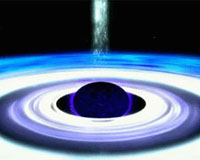
Greenbelt MD (SPX) Oct 06, 2006 NASA scientists and their international partners using the new Japanese Suzaku satellite have collected a startling new set of black hole observations, revealing details of twisted space and warped time never before seen with such precision. The observations include clocking the speed of a black hole's spin rate and measuring the angle at which matter pours into the void, as well as evidence for a wall of X-ray light pulled back and flattened by gravity. The findings rely on a special feature in the light emitted close to the black hole, called the "broad iron K line," once doubted by some scientists because of poor resolution in earlier observations, now unambiguously revealed as a true measure of a black hole's crushing gravitational force. This technique can be exploited in future X-ray missions. "Across the board, we are finding the broad iron K line to be an incredibly robust measure of black hole properties," said Andrew Fabian of Cambridge University, England, who led one of the teams. "We are entering the era of precision black hole measurements." Fabian is the team leader on Suzaku's black hole spin and light-bending observations. James Reeves of NASA's Goddard Space Flight Center, Greenbelt, Md., and Johns Hopkins University, Baltimore, led a second team that observed the first accurate measurement of the angle of a disk of material swirling around a black hole. Suzaku contains a high-energy X-ray detector and an X-ray spectrograph. Together, these instruments detect a broad range of X-ray energies, particularly the higher X-ray energies. Supermassive black holes are a prime target. These are objects in the center of most galaxies, containing the mass of millions to billions of suns confined within a region about the size of our solar system. This spectral signal has been seen before, most recently with Europe's XMM-Newton satellite in the very same black holes observed by Suzaku. However, Suzaku has a higher sensitivity at this important energy range compared to other telescopes. And Suzaku detects even higher energies, far above 6.4 keV, also with high sensitivity. This combination is a unique satellite feature and provides a more complete picture of black hole activity. A series of Suzaku observations conducted in 2005 and 2006 demonstrates that the broad iron K line is found coming from almost all galaxies and that the signal is real, from strong gravity, and not noise due to poor resolution. Future X-ray missions can build upon this discovery and use the broad iron K line to "image" a black hole, a long-term goal for NASA space exploration. In a galaxy called MCG-6-30-15, Fabian's group confirmed that the central black hole is spinning rapidly, taking space and time along for a ride with it. The group found evidence that X-rays emitted close to the black hole, trying to escape, are bent back into the disk of matter flowing inward, away from us. This is predicted by Einstein's general relativity, hinted at in earlier observations, but seen in remarkable new detail with Suzaku. In a galaxy called MCG-5-23-16, Reeves' team determined that the disk of material feeding the black hole, called the accretion disk, is angled at 45 degrees with respect to our line of sight. Such a precision measurement has not been possible before. "The broad iron K line is our ticket to view matter and energy very close to a black hole," said Reeves. "Only by probing the extremes of gravity will we find flaws, if any, in Einstein's theories." Launched in 2005, Suzaku is the fifth in a series of Japanese satellites devoted to studying celestial X-ray sources and is managed by the Japan Aerospace Exploration Agency (JAXA). This mission is a collaborative effort between Japanese universities and institutions and NASA Goddard, which provided the X-ray mirrors. Community Email This Article Comment On This Article Related Links Goddard Space Flight Center at NASA Stellar Chemistry, The Universe And All Within It Understanding Time and Space
 NASA Performs Headcount of Local Black Holes
 Greenbelt MD (SPX) Oct 06, 2006
NASA scientists using the Swift satellite have conducted the first complete census of galaxies with active, central black holes, a project that scanned the entire sky several times over a nine-month period. |
|
|

| The content herein, unless otherwise known to be public domain, are Copyright 1995-2006 - SpaceDaily.AFP and UPI Wire Stories are copyright Agence France-Presse and United Press International. ESA PortalReports are copyright European Space Agency. All NASA sourced material is public domain. Additionalcopyrights may apply in whole or part to other bona fide parties. Advertising does not imply endorsement,agreement or approval of any opinions, statements or information provided by SpaceDaily on any Web page published or hosted by SpaceDaily. Privacy Statement |