|
 |
 |
 |
 |
 |
 |
 |
 |

 |
Scientists Measure How Deep "Deep Impact" Was, With X-rays
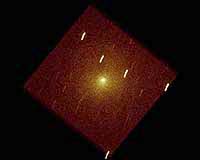
Leicester UK (SPX) Jul 11, 2005 Here come the X-rays, on cue. Scientists studying the Deep Impact collision using NASA's Swift satellite report that comet Tempel 1 is getting brighter and brighter in X-ray light with each passing day. The X-rays provide a direct measurement of how much material was kicked up in the impact. This is because the X-rays are created by the newly liberated material lifted into the comet's thin atmosphere and illuminated by the high-energy solar wind from the Sun. The more material liberated, the more X-rays are produced. Swift data of the water evaporation on comet Tempel 1 also may provide new insights into how solar wind can strip water from planets such as Mars. "Prior to its rendezvous with the Deep Impact probe, the comet was a rather dim X-ray source," said Dr. Paul O'Brien of the Swift team at the University of Leicester. "How things change when you ram a comet with a copper probe traveling over 20,000 miles per hour. Most of the X-ray light we detect now is generated by debris created by the collision. We can get a solid measurement of the amount of material released." "It takes several days after an impact for surface and sub-surface material to reach the comet's upper atmosphere, or coma," said Dr. Dick Willingale, also of the University of Leicester. "We expect the X-ray production to peak this weekend. Then we will be able to assess how much comet material was released from the impact." Based on preliminary X-ray analysis, O'Brien estimates that several tens of thousands of tons of material were released, enough to bury Penn State's football field under 30 feet of comet dust. Observations and analysis are ongoing at the Swift Mission Operations Center at Penn State University as well as in Italy and the United Kingdom. Swift is providing the only simultaneous multi-wavelength observation of this rare event, with a suite of instruments capable of detecting visible light, ultraviolet light, X-rays, and gamma rays. Different wavelengths reveal different secrets about the comet. The Swift team hopes to compare the satellite's ultraviolet data, collected hours after the collision, with the X-ray data. The ultraviolet light was created by material entering into the lower region of the comet's atmosphere; the X-rays come from the upper regions. Swift is a nearly ideal observatory for making these comet studies, as it combines both a rapidly responsive scheduling system with both X-ray and optical/UV instruments in the same satellite. "For the first time, we can see how material liberated from a comet's surface migrates to the upper reaches of its atmosphere," said Prof. John Nousek, Director of Mission Operations at Penn State. "This will provide fascinating information about a comet's atmosphere and how it interacts with the solar wind. This is all virgin territory." Nousek said Deep Impact's collision with comet Tempel 1 is like a controlled laboratory experiment of the type of slow evaporation process from solar wind that took place on Mars. The Earth has a magnetic field that shields us from solar wind, a particle wind composed mostly of protons and electrons moving at nearly light speed. Mars lost its magnetic field billions of years ago, and the solar wind stripped the planet of water. Comets, like Mars and Venus, have no magnetic fields. Comets become visible largely because ice is evaporated from their surface with each close passage around the Sun. Water is dissociated into its component atoms by the bright sunlight and swept away by the fast-moving and energetic solar wind. ' Scientists hope to learn about this evaporation process on Tempel 1 now occurring quickly - over the course of a few weeks instead of a billion years - as the result of a planned, human intervention. Swift's "day job" is detecting distant, natural explosions called gamma-ray bursts and creating a map of X-ray sources in the universe. Swift's extraordinary speed and agility enable scientists to follow Tempel 1 day by day to see the full effect from the Deep Impact collision. Community Email This Article Comment On This Article Related Links Deep impact at NASA Swift analysis of comet Tempel 1 SpaceDaily Search SpaceDaily Subscribe To SpaceDaily Express Asteroid and Comet Impact Danger To Earth - News and Science
 A Comet's Only Cameraman
 Moffett Field CA (SPX) Aug 12, 2005
Digital effects artist Dan Maas has a vision that " small teams... create works of spectacular scope and great complexity", a dream that he has now shown the world both on Mars and a comet. |
|
|

| The content herein, unless otherwise known to be public domain, are Copyright 1995-2006 - SpaceDaily.AFP and UPI Wire Stories are copyright Agence France-Presse and United Press International. ESA PortalReports are copyright European Space Agency. All NASA sourced material is public domain. Additionalcopyrights may apply in whole or part to other bona fide parties. Advertising does not imply endorsement,agreement or approval of any opinions, statements or information provided by SpaceDaily on any Web page published or hosted by SpaceDaily. Privacy Statement |