|
 |
 |
 |
 |
 |
 |
 |
 |

 |
Scientists Look to Help Soldiers Overcome High Altitude
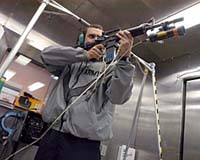
Natick MA (AFNS) Oct 10, 2006 Scientists at the U.S. Army Research Institute of Environmental Medicine are investigating ways to help soldiers adjust to high-altitude environments. Soldiers being sent to Afghanistan are often quickly deployed to high-altitude environments via helicopter, leaving little time for their bodies to adjust and putting them at risk for contracting high-altitude sickness. High-altitude conditions, which include adjusting to less oxygen and thinner atmosphere, can impact even the most physically fit soldier. According to the institute's Dr. Stephen Muza, high-altitude conditions, at a minimum, affect stamina and cause soldiers to fatigue much more quickly. Other problems can develop as well. The most prevalent type of altitude sickness is acute mountain sickness, which can cause headaches, dizziness, nausea, and make it difficult to fall asleep. According to Muza, acute mountain sickness typically occurs within 4-12 hours. Although most people experience the aforementioned symptoms of the sickness, 100 percent of the population experiences a decline in task performance. "Soldiers can still make accurate decisions, but it takes them longer to do so. Altitudes above 5000 feet can impair vision, especially the ability to see color," Muza said. Acute mountain sickness symptoms will often dissipate once a soldier's body adjusts to the high-altitude environment, but sometimes the sickness can intensify into pulmonary edema, which is caused by a build up of fluid in the lungs and can lead to shortness of breath and heavy coughing. Acute mountain sickness can also transform into cerebral edema, which is caused by an increased blood flow to the brain. Cerebral edema can cause swelling, disorientation, hallucinations and can impact physical coordination. It can be deadly if left untreated. Research institute scientists are investigating the use of pre-exposure to high-altitude conditions to prevent altitude sickness to help soldiers who need to make sudden and prolonged ascents to altitudes of 5,000 to 14,000 feet. Soldiers will perform a myriad of typical tasks in the research institute's Hypoxia Room and Hybobaric Chamber, which replicates a high-altitude environment. The Hypoxia Room is a low-cost, low-oxygen environment and can be replicated anywhere, even in small nuclear, biological, and chemical (NBC) shelters. The study will document changes in soldier performance under both high-altitude and low-altitude conditions. The study will also document changes in performance and well-being before and after Hypoxia Room treatments. The research institute's investigation will reveal exactly how much time soldiers need to be exposed to high-altitude conditions to offset the effects of altitude sickness. Based on observations so far, Muza said it appears soldiers exposed to 10,000 - 14,500 feet for three or four hours a day are ready to undertake their mission with less sickness and higher performance. According to Muza, if the Hypoxia room treatments are done over six to seven days, it has been found that the treatments can increase physical stamina by 30 percent and can reduce or eliminate acute mountain sickness. Research institute scientists have found that two-thirds of improvement occurs during the first week of treatments. One result of the study will be the creation of altitude preparation guidelines. Muza said that the institute's research will develop predictive models to determine rates of decline in physical and cognitive abilities in correlation to how fast soldiers need to ascend. In addition to the Hypoxia Room treatments, recently completed studies by Muza's team have determined that a high-carbohydrate diet in high-altitude conditions improves soldier stamina and appears to reduce acute mountain sickness. However, taking anti-oxidants or creatine did not lessen the effects of high-altitude exposure. Muza says that future studies will examine several other ways to lesson the effects of exposure to high-altitude conditions. The study should be completed sometime prior to the end of 2006. Community Email This Article Comment On This Article Related Links U.S. Army Research Institute of Environmental Medicine The latest in Military Technology for the 21st century at SpaceWar.com The latest in Military Technology for the 21st century at SpaceWar.com
 Raytheon Delivers First Excalibur Production Rounds To The US Army
 Tucson AZ (SPX) Oct 10, 2006
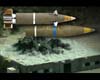
The Raytheon Missile Systems and BAE Systems Bofors' Excalibur team delivered the first production Excalibur global positioning system-guided 155 mm artillery rounds to the U.S. Army Sept. 19, paving the way for the next series of testing required to field the weapon in theater early next year. Final assembly of the projectiles occurred at the McAlester Army Ammunition Plant in McAlester, Okla. |
|
|

| The content herein, unless otherwise known to be public domain, are Copyright 1995-2006 - SpaceDaily.AFP and UPI Wire Stories are copyright Agence France-Presse and United Press International. ESA PortalReports are copyright European Space Agency. All NASA sourced material is public domain. Additionalcopyrights may apply in whole or part to other bona fide parties. Advertising does not imply endorsement,agreement or approval of any opinions, statements or information provided by SpaceDaily on any Web page published or hosted by SpaceDaily. Privacy Statement |