|
 |
 |
 |
 |
 |
 |
 |
 |

 |
Scientists Levitate Heaviest Elements With Help From Cold Oxygen
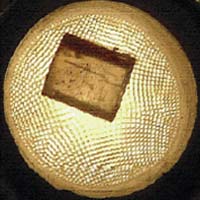
Nottingham, UK (SPX) May 11, 2005 Scientists at the University of Nottingham have successfully levitated diamond and some of the heaviest elements, including lead and platinum. Using liquid oxygen to increase the buoyancy created by a specially designed superconducting magnet, they could now levitate a hypothetical object with a density 15 times larger than that of the densest known material, osmium. This research is published today (11th May 2005) in the New Journal of Physics co-owned by the Institute of Physics and Deutsche Physikalische Gesellschaft (the German Physical Society). Writing in the New Journal of Physics, the team led by Professor Laurence Eaves and Professor Peter King, describes for the first time how mixtures of oxygen and nitrogen in the liquid and gaseous states provide sufficient buoyancy to levitate a wide variety of objects including diamonds, a �1 coin, and heavy metals such as gold, silver, lead and platinum. Some materials, called diamagnetic, tend to become magnetized in a direction opposite to the magnetic field being applied to them. Magnetic levitation occurs when the force on such an object is strong enough to balance the weight of the object itself. If the object is immersed in a fluid such as gaseous oxygen, the levitation can be enhanced by the effect of buoyancy caused by the "magneto-Archimedes" effect. Liquid oxygen, the main component in many rocket fuels, is highly combustible. It is potentially dangerous to use but makes it much easier to float dense objects using commercially available magnets because it boosts the buoyancy effect due to the inherent magnetism of each molecule of oxygen. This allows you to float objects as heavy as gold with relatively low-power magnets. Eaves and King and their co-workers have now investigated the use of a safer mixture of liquid nitrogen and oxygen, and found the optimum mixture for floating heavy objects in safety, making commercial applications of this technology possible. Levitating heavy objects in this way has a variety of potential applications, especially in the mining and pharmaceutical industries. In mining for precious stones such as diamonds, a method for accurately filtering the gems you want from the surrounding rock and soil is worth its weight in gold. Peter King explains: "You can use this technology to accurately sort minerals. Under vibration you throw crushed ore into the air and in the magnet the different components experience different effective gravity. "They therefore tend to land at different times and after a short while the vibration sorts them into bands according to their density. "The method can discriminate between components with very small differences in density enabling you to extract the precious parts you require." Their research lab is also the only facility in the UK specializing in zero-gravity experiments, and is currently being used by various research groups including one studying how plants germinate and grow in zero-gravity conditions, essential knowledge for long-haul space flights. Community Email This Article Comment On This Article Related Links University of Nottingham SpaceDaily Search SpaceDaily Subscribe To SpaceDaily Express Space Technology News - Applications and Research
 NGC Chosen To Proceed With Developing Solid-State Laser Technology For Military Applications
 Redondo Beach CA (SPX) Jan 09, 2006
Northrop Grumman Corporation has been selected to develop "military-grade," solid-state laser technology that is expected to pave the way for the U.S. military to incorporate high-energy laser systems across all services, including ships, manned and unmanned aircraft, and ground vehicles. |
|
|

| The content herein, unless otherwise known to be public domain, are Copyright 1995-2006 - SpaceDaily.AFP and UPI Wire Stories are copyright Agence France-Presse and United Press International. ESA PortalReports are copyright European Space Agency. All NASA sourced material is public domain. Additionalcopyrights may apply in whole or part to other bona fide parties. Advertising does not imply endorsement,agreement or approval of any opinions, statements or information provided by SpaceDaily on any Web page published or hosted by SpaceDaily. Privacy Statement |