|
 |
 |
 |
 |
 |
 |
 |
 |

 |
Scientists Learning To Create Nanomaterials Based On Micro-Algae Patterns
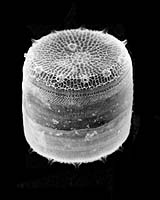
Atlanta GA (SPX) Dec 08, 2006 Researchers at the Georgia Institute of Technology have developed a technique to study how unicellular micro-algae, known as diatoms, create their complex cell walls. Researchers hope to learn how diatoms assemble these nanometer-patterned, intricate micro-architectures to find better methods for creating nanomaterials in the laboratory. "Diatoms are nature's most gifted nanotechnologists," said Nils Kroger, an assistant professor in Georgia Tech's School of Chemistry and Biochemistry and the School of Materials Science and Engineering. "We want to learn how diatom cell walls are produced because human technology can't make something that intricate by self-assembly processes and under ambient conditions." Diatoms are single-celled organisms that frequently appear as a brown, slippery coating on submerged stones and as phytoplankton in the open ocean. Tiny pores in the cell wall allow diatoms to exchange nutrients with the environment and remain at the surface of the water to absorb sunlight for photosynthesis. Diatom photosynthesis is responsible for 20 percent of the world's organic carbon. The pores allow diatoms to be lightweight, but their cell wall gives them a strong mechanical structure. The strength of the cell wall comes from amorphous silica, or silicon dioxide (SiO2) -- virtually the same material as glass. Diatom cell walls show an enormous diversity in form, most of them amazingly beautiful and ornate, depending on specific biomolecules produced by the diatom, Kroger explained. Previous research has shown that uniquely modified proteins called silaffins and extremely long polyamine chains play a role in the structural design of the cell wall. Kroger hypothesizes that the structure of the diatom silica critically depends on the type of silaffin present within the diatoms' silica-producing organic matrix. Therefore, he expects that changing the "silaffin equipment" of a diatom cell should result in novel silica nanostructures. Kroger and collaborator Nicole Poulsen, a postdoctoral researcher in the School of Chemistry and Biochemistry, have developed a technique to genetically engineer diatoms. The process allows insertion of mutated or foreign genes into the genome of the diatom Thalassiosira pseudonana. Kroger believes this technique will enable the creation of diatoms with novel silica structures. He will describe the technique in an invited presentation on Dec. 12 at the fall meeting of the American Geophysical Union. Genetic manipulation of diatoms will increase the understanding of their cellular biochemistry and potentially enable the use of these organisms for the production of commercially valuable compounds and materials, Kroger said. But inserting a gene through the strong silica cell wall is difficult. The wall must be penetrated, but not broken, and the foreign gene must be accepted into the diatom's genome, he explained. To insert the genes, such as those that encode different silaffins, through the diatom cell wall, Kroger and Poulsen use a technique called microparticle bombardment. DNA-coated tungsten particles are "shot" on the diatoms under high heliumpressure, thus enabling them to penetrate the strong diatom cell wall. The diatom incorporates the introduced DNA into its genome, and selection of the transfected cells is achieved using the antibiotic nourseothricin. When new genes are introduced with the technique developed by Kroger and Poulsen, they can be expressed constantly or be turned on and off when necessary. Specific details of the technique were published in the October 2006 issue of the Journal of Phycology. Kroger and Poulsen established this technique for the diatom Thalassiosira pseudonana because it is currently the only diatom species with a completely sequenced genome. "Knowing the genome sequence and having established a method for genetic modification of this organism means we can, in principle, analyze the function of every gene and the protein that it encodes," Kroger said. "This will eventually enable us to identify the key cellular biomolecules involved in creating the strong, intricately patterned diatom cell walls." The research has been supported by a grant from the Office of Naval Research and the Defense Advanced Research Projects Agency. Community Email This Article Comment On This Article Related Links Georgia Institute of Technology, Research Communications Nano Technology News From SpaceMart.com Nano Technology News From SpaceMart.com Computer Chip Architecture, Technology and Manufacture
 Former White House Science Advisor Warns Nanotechnology Potential Threatened
 Washington DC (SPX) Dec 06, 2006
"Nanoscale science and engineering promise to be as important as the steam engine, the transistor, and the Internet, and have the potential to revolutionize all other technologies" according to Neal Lane, former science advisor to U.S. President Bill Clinton. "But that outcome is not guaranteed." |
|
|

| The content herein, unless otherwise known to be public domain, are Copyright 1995-2006 - SpaceDaily.AFP and UPI Wire Stories are copyright Agence France-Presse and United Press International. ESA PortalReports are copyright European Space Agency. All NASA sourced material is public domain. Additionalcopyrights may apply in whole or part to other bona fide parties. Advertising does not imply endorsement,agreement or approval of any opinions, statements or information provided by SpaceDaily on any Web page published or hosted by SpaceDaily. Privacy Statement |