|
 |
 |
 |
 |
 |
 |
 |
 |

 |
Scientists Investigate Giant Algae Bloom Off Canadian West Coast
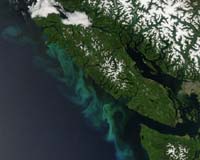
Vancouver, Canada (AFP) Jun 29, 2006 A giant growth of algae in the waters off Canada's west coast, so huge it can be seen from space, may be linked to climate change, say scientists who hope to collect samples Friday for analysis. The growth, called a bloom, became visible in late June on NASA satellite images, said Jim Gower, a physicist with the Institute of Ocean Sciences in Sydney, in British Columbia province. The images show swirls of chalky green in the darker waters off Vancouver Island. Initial reports suggested the bloom could be toxic to humans and wildlife, but these fears have largely been dismissed. "At this time of year, we always get a lot of plankton growing off the west coast of the island," Gower told AFP Thursday. "We like it -- that's why the salmon fishing is so good. ... But we're worried the patterns may change with global climate change." The bloom is caused by coccolithphore algae, which leave minute amounts of chalk in the water and which scientists believe created the limestone deposits off England known as the White Cliffs of Dover. "This is the biggest (bloom) we've seen off our coast. We're looking at the White Cliffs of Tofino if this continues," Gower quipped, referring to a town on the province's remote west coast. Scientists from the institute will sail Friday on a research vessel to collect samples of the algae. Unlike other algae which produce toxins, known as red tide, coccolithphore algae is not poisonous. But in vast quantities, it could harm other marine life, said institute research scientist Angelica Pena. Alive, the algae produces oxygen, but when it dies and decomposes, it can consume so much oxygen from the water that fish and marine mammals will die. Algae blooms are sometimes linked to pollution runoff from land, but in this case the bloom is far from sources such as fertilizers, said Gower. Canadian scientists reported earlier this month that Pacific temperatures off the west coast have been higher since 2003 than at any period since 1880, though they dipped in 2005 compared with 2004.
Source: Agence France-Presse Community Email This Article Comment On This Article Related Links - Darwin Today At TerraDaily.com
 Scientists Puzzled By Sand Bacteria
 Mount Pleasant (UPI) Jun 30, 2006
U.S. scientists say bacteria forcing the closure of many beaches may not be coming from people, animals, or sewage -- but might be produced in the sand. Researchers at Central Michigan University say they have found E. coli can live and thrive in beach sand without a warm-blooded host. |
|
|

| The content herein, unless otherwise known to be public domain, are Copyright 1995-2006 - SpaceDaily.AFP and UPI Wire Stories are copyright Agence France-Presse and United Press International. ESA PortalReports are copyright European Space Agency. All NASA sourced material is public domain. Additionalcopyrights may apply in whole or part to other bona fide parties. Advertising does not imply endorsement,agreement or approval of any opinions, statements or information provided by SpaceDaily on any Web page published or hosted by SpaceDaily. Privacy Statement |