|
 |
 |
 |
 |
 |
 |
 |
 |

 |
Scientists Help Develop First Single Molecule Transistor
Liverpool UK (SPX) Jun 08, 2005 Dr Werner Hofer, from the University of Liverpool's Surface Science Research Centre, is one of an international team of scientists who have created a prototype that demonstrates a single charged atom on a silicon surface can regulate the conductivity of a nearby molecule. Computers and other technology based on this concept would require much less energy to power, would produce much less heat, and run much faster. Currently, most electronic devices are based on silicon. There is, however, a limit to how many transistors can be packed into a given volume of silicon as the currents in these transistors are high and can overheat. By miniaturizing a transistor, the time during which an electron can pass through it is reduced and therefore the device can be operated with much higher frequencies and take up much less space. Dr Hofer, a theorist, who worked in collaboration with colleagues from the National Institute for Nanotechnology of the National Research Council in Canada and the University of Alberta, provided the theoretical background in an experiment to examine the potential for electrical transistors on a much smaller, molecular scale. Their findings have been published in the journal, Nature. Molecules are extremely small, on the scale of a nanometre (one billionth of a metre). The team tested the transistor potential of a molecule by using the electrostatic field emanating from a single atom to regulate the conductivity of a molecule, allowing an electric current to flow through the molecule. These effects were easily observed at room temperature, in contrast to previous molecular experiments that had to be conducted at temperatures close to absolute zero, and with much smaller current amplification. Dr Hofer explains: "Our experiments demonstrate that we can control the current through a single molecule by charging a single atom on a silicon surface, while all surrounding atoms remain neutral. "Our research brings us a step nearer to using molecular electronics which would not only prove more efficient and cheaper than current devices, but would also have the potential to power green technology because of the biodegradable nature of the device." He added: "Our prototype is a scientific breakthrough in molecular electronics. We have successfully shown the potential for devices of unheard-of smallness and unheard-of efficiency. This is the first time anyone has shown that a molecule is in fact a transistor." Community Email This Article Comment On This Article Related Links University of Liverpool SpaceDaily Search SpaceDaily Subscribe To SpaceDaily Express Space Technology News - Applications and Research
 Industry Team Achieve New Communications Technology With AESA Radars
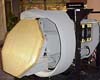 Baltimore MD (SPX) Jan 12, 2006
A team comprised of three leading US aerospace and defense contractors has demonstrated an innovative technological use of active electronically scanned array (AESA) radars for high-bandwidth communications. |
|
|

| The content herein, unless otherwise known to be public domain, are Copyright 1995-2006 - SpaceDaily.AFP and UPI Wire Stories are copyright Agence France-Presse and United Press International. ESA PortalReports are copyright European Space Agency. All NASA sourced material is public domain. Additionalcopyrights may apply in whole or part to other bona fide parties. Advertising does not imply endorsement,agreement or approval of any opinions, statements or information provided by SpaceDaily on any Web page published or hosted by SpaceDaily. Privacy Statement |