|
 |
 |
 |
 |
 |
 |
 |
 |

 |
Scientists Find That Saturn's Rotation Period Is A Puzzle
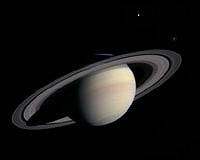
Pasadena (JPL) Jun 29, 2004 On approach to Saturn, data obtained by the Cassini spacecraft are already posing a puzzling question: How long is the day on Saturn? Cassini took readings of the day-length indicator regarded as most reliable, the rhythm of natural radio signals from the planet. The results give 10 hours, 45 minutes, 45 seconds (plus or minus 36 seconds) as the length of time it takes Saturn to complete each rotation. Here's the puzzle: That is about 6 minutes, or one percent, longer than the radio rotational period measured by the Voyager 1 and Voyager 2 spacecraft, which flew by Saturn in 1980 and 1981. Cassini scientists are not questioning Voyager's careful measurements. And they definitely do not think the whole planet of Saturn is actually rotating that much slower than it did two decades ago. Instead, they are looking for an explanation based on some variability in how the rotation deep inside Saturn drives the radio pulse. "The rotational modulation of radio emissions from distant astronomical objects has long been used to provide very accurate measurements of their rotation period," said Dr. Don Gurnett, principal investigator for the Cassini Radio and Plasma Wave Science instrument, University of Iowa, Iowa City. "The technique is particularly useful for the giant gas planets, such as Jupiter and Saturn, which have no surfaces and are covered by clouds that make direct visual measurements impossible." The first hint of something strange about that type of measurement at Saturn was in 1997, when a researcher from Observatoire de Paris reported that Saturn's radio rotation period differed substantially from Voyager. Dr. Michael D. Desch, Cassini Radio Plasma Wave Science team member, and scientist at NASA's Goddard Space Flight Center in Greenbelt, Md., has analyzed Saturn radio data collected by Cassini from April 29, 2003, to June 10, 2004. "We all agree that the radio rotation period of Saturn is longer today than it was in during the Voyager flyby in 1980," he said. Gurnett said, "Although Saturn's radio rotation period has clearly shifted substantially since the Voyager measurements, I don't think any of us could conceive of any process that would cause the rotation of the entire planet to actually slow down." "So it appears that there is some kind of slippage between the deep interior of the planet and the magnetic field, which controls the charged particles responsible for the radio emission." He suggests the solution may be tied to the fact that Saturn's rotational axis is nearly identical to its magnetic axis. Jupiter, with a more substantial difference between its magnetic axis and its rotational axis, shows no comparable irregularities in its radio rotation period. "This finding is very significant. It demonstrates that the idea of a rigidly rotating magnetic field is wrong," said Dr. Alex Dessler, a senior research scientist at the University of Arizona, Tucson. In that way, the magnetic fields of gas giant planets may resemble that of the Sun. The Sun's magnetic field does not rotate uniformly. Instead, its rotation period varies with latitude. "Saturn's magnetic field has more in common with the Sun than the Earth. The measurement can be interpreted as showing that the part of Saturn's magnetic field that controls the radio emissions has moved to a higher latitude during the last two decades," said Dressler. "I think we will be able to unravel the puzzle, but it's going to take some time," said Gurnett. "With Cassini in orbit around Saturn for four years or more, we will be in an excellent position to monitor long-term variations in the radio period, as well as investigate the rotational period using other techniques." Community Email This Article Comment On This Article Related Links Cassini- Huygens Mission SpaceDaily Search SpaceDaily Subscribe To SpaceDaily Express Explore The Ring World of Saturn and her moons Jupiter and its Moons The million outer planets of a star called Sol News Flash at Mercury
 Cassini Images Halo Around Titanic Moon Off Saturn
 Pasadena CA (SPX) Dec 27, 2005
With its thick, distended atmosphere, Titan's orange globe shines softly, encircled by a thin halo of purple light-scattering haze. |
|
|

| The content herein, unless otherwise known to be public domain, are Copyright 1995-2006 - SpaceDaily.AFP and UPI Wire Stories are copyright Agence France-Presse and United Press International. ESA PortalReports are copyright European Space Agency. All NASA sourced material is public domain. Additionalcopyrights may apply in whole or part to other bona fide parties. Advertising does not imply endorsement,agreement or approval of any opinions, statements or information provided by SpaceDaily on any Web page published or hosted by SpaceDaily. Privacy Statement |