|
 |
 |
 |
 |
 |
 |
 |
 |

 |
Scientists Find New Carbon Pollution Called Tar Balls
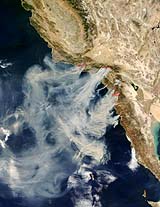
Washington - Mar 22, 2004 An international team of scientists has discovered new carbon-bearing particles, which they call "tar balls," in air pollution over Hungary, the Indian Ocean, and southern Africa. Tar balls form in smoke from wood fires and agricultural and forest burning. Carbon-bearing particles like tar balls in the lower atmosphere are a concern, they say, because they may affect global climate change, as well as air quality. The team, headed by Mih�ly P�sfai, an Earth and environmental science professor at the University of Veszpr�m in Hungary, completed the first comprehensive study of tar balls and report their findings this month in the Journal of Geophysical Research--Atmospheres, published by the American Geophysical Union. "They are especially abundant in slightly aged--minutes to hours old--biomass [vegetal] smoke," says co-author Peter Buseck, a geochemist at Arizona State University. That means they probably formed from gases in smoke plumes, he says, and contain organic compounds that absorb sunlight. "Tar balls occur in a variety of atmospheric environments that are affected by human activities," he says. At first glance, tar balls may look like soot, a common form of carbon pollution in the air, but when observed through an electron microscope, the differences become clear, the researchers say. "Soot forms in the flame and consists of spheres," P�sfai says. Each soot sphere is made of graphitic layers that are concentrically wrapped like the layers of an onion and, with other soot spheres, forms chains or grape-like clusters, he says. Tar balls, on the other hand, are just individual spheres and do not form chains or clusters. They lack any internal structure and don't have onion-like layers in them. "The internal structure affects the optical properties of the particle--the more ordered the graphitic structure, the darker the color," P�sfai explains. "Dark particles absorb sunlight and thereby heat the atmosphere." While black soot is the major absorber of sunlight in the atmosphere, tar balls may also be absorbing sunlight. "And this is significant," he says. Community Email This Article Comment On This Article Related Links American Geophysical Union SpaceDaily Search SpaceDaily Subscribe To SpaceDaily Express Earth Observation News - Suppiliers, Technology and Application
 New Legislation Initiated To Support Commercial Remote Sensing Industry
 New York NY (SPX) Jan 11, 2006
The importance of remotely sensed data and technologies to support natural disasters has prompted attention and action in Washington. New initiatives and legislation authorizing appropriations to the remote sensing industry will be discussed at Strategic Research Institute's U.S. Commercial Remote Sensing Industry conference, scheduled for February 9-10, 2006 in Washington D.C. |
|
|

| The content herein, unless otherwise known to be public domain, are Copyright 1995-2006 - SpaceDaily.AFP and UPI Wire Stories are copyright Agence France-Presse and United Press International. ESA PortalReports are copyright European Space Agency. All NASA sourced material is public domain. Additionalcopyrights may apply in whole or part to other bona fide parties. Advertising does not imply endorsement,agreement or approval of any opinions, statements or information provided by SpaceDaily on any Web page published or hosted by SpaceDaily. Privacy Statement |