|
 |
 |
 |
 |
 |
 |
 |
 |

 |
Scientists Expose Current Turbulence Theory As Too Simple
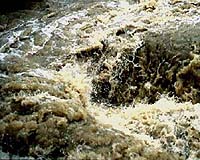
Coventry, UK (SPX) Apr 14, 2005 Researchers at the University of Warwick have trashed the world's biggest turbulence lab by turning a pleasant stream into a raging torrent - but they say their actions will lead new understandings in one of the main unsolved problems in physics- turbulence. Turbulence is one of the main unsolved problems in physics. Turbulent systems fluctuate wildly and understanding this will also help scientists understand (and put a number on the likelihood of) extreme events in other systems that look the same in terms of the mathematics, such as the weather, and stock market prices. It is technically very challenging to study turbulence on earth, either in the laboratory or on even the largest computers that are available. A very large experiment is needed, and so researchers have turned to space to use the whole solar system as a turbulence laboratory. The solar system is filled by the sun's expanding atmosphere - the solar wind, we see its effects directly here on earth as "space weather" (the northern lights). The solar wind also effects how cosmic rays reach the earth, which may have important consequences for earth weather and climate change. A familiar example of turbulence is a stream flowing over a weir. A trick often used to study this is to follow a "passive scalar" - an element of the flow that follows the flow but does not cause or suffer significant change. In the case of a stream a passive scalar might be a leaf floating downstream. In the case of the solar wind it was hoped that the density of the wind is passive, allowing researchers to use a relatively simple set of mathematical tools to model the turbulence. However new results about to appear in Physics Review Letters by researchers at the University of Warwick has shown that the density in the solar wind behaves less like a leaf in a stream and more like a pile of enormous boulders and tree trunks being smashed along a raging torrent of water. The research by Dr Bogdan Hnat, Professor Sandra Chapman, and Professor George Rowlands at The University of Warwick's Department of Physics, and which drew on data from the NASA ACE satellite indicates that turbulence scientists will have to abandon using the density of the solar wind as their "passive scalar" leaf and seek more complex solutions to their problems. Community Email This Article Comment On This Article Related Links ACE mission at Caltech University of Warwick SpaceDaily Search SpaceDaily Subscribe To SpaceDaily Express Understanding Time and Space
 Unified Physics Theory Explains Animals Running Flying And Swimming
 Durham NC (SPX) Jan 05, 2006
A single unifying physics theory can essentially describe how animals of every ilk, from flying insects to fish, get around, researchers at Duke University's Pratt School of Engineering and Pennsylvania State University have found. The team reports that all animals bear the same stamp of physics in their design. |
|
|

| The content herein, unless otherwise known to be public domain, are Copyright 1995-2006 - SpaceDaily.AFP and UPI Wire Stories are copyright Agence France-Presse and United Press International. ESA PortalReports are copyright European Space Agency. All NASA sourced material is public domain. Additionalcopyrights may apply in whole or part to other bona fide parties. Advertising does not imply endorsement,agreement or approval of any opinions, statements or information provided by SpaceDaily on any Web page published or hosted by SpaceDaily. Privacy Statement |