|
 |
 |
 |
 |
 |
 |
 |
 |

 |
Scientists Explore Genome Of Methane-Breathing Microbe
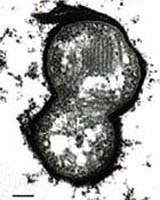
Rockville MD (SPX) Sep 22, 2004 The first complete genome sequence of a methane-breathing bacterium has revealed a surprising flexibility in its metabolism, suggesting an ability to live successfully in environments previously thought to be beyond its reach. The genome sequence of Methylococcus capsulatus � a species typical of methane-breathing bacteria commonly found in soils, landfills, sediments and peat bogs � includes a full and at times redundant toolkit of genes for using methane as an energy and carbon source. Such methane-consuming microbes are called methanotrophs. The study, to be published in the October issue of PLoS Biology and posted online this week, found an unexpected flexibility in M. capsulatus metabolic pathways, hinting that the bacterium is capable of responding to changes in its environment by functioning through different chemical pathways for using methane. That finding, if confirmed by later experiments, may increase the bacterium's potential as a biotech workhorse. Methanotrophs play an important role in the global energy cycle because they consume methane, a gas that is produced mostly by chemical processes in landfills, in the guts of ruminant livestock such as cows, and by oil and natural gas processing plants. In recent years, environmental scientists have shown increasing interest in methanotrophs because their use of methane as a sole source of carbon and energy could possibly be harnessed to play an important role in efforts to reduce methane emissions that are generated by biological sources such as ruminants and landfills. The PLoS Biology study found that M. capsulatus has multiple pathways for different stages in the oxidation of methane. They also found genes that suggest metabolic flexibility, including the microbe's likely ability to grow on sugars, to oxidize sulfur, and to live in reduced-oxygen environments. "We now have a much better picture of the relationship between M. capsulatus and its environment," says Naomi Ward, the paper's first author. "It is important for us to know under what conditions methane can be removed from the ecosystem before it accumulates as a greenhouse gas." Ward is an Assistant Investigator at The Institute for Genomic Research (TIGR), which led the genomic sequencing and conducted the analysis with scientific collaborators at the University of Bergen in Norway. While noting that "there is a clear need for experimental validation" of the metabolic pathways suggested by the genome, the study's authors suggest that their analysis "deepens our understanding of methanotroph biology, its relationship to global carbon cycles, and its potential for biotechnological applications." Johan Lillehaug, the Norwegian scientist who oversaw the University of Bergen's role in the project, says the genome analysis found that M. capsulatus has a novel strategy for scavenging copper, an essential element for regulating methane oxidation. "We found that M. capsulatus is a good model for studying how microbes adapt to varying copper concentrations," he says, noting that M. capsulatus uses two separate systems � at high and low copper concentrations � for oxidizing methane. Scientists say the organism's potential significance for biotechnology include the use of bacteriophage (viruses that infect bacteria) that have made a home in the genome. Such phages could be exploited to genetically manipulate M. capsulatus to more efficiently produce microbial protein for commercial animal feed. The study's senior author, TIGR Investigator Jonathan Eisen, says the analysis of M. capsulatus also will help scientists learn more about some methane-fixing bacteria � those that live inside of animals such as clams and mussels in deep-sea methane seeps � that are extremely difficult to study. Such methane-fixing bacterial symbionts allow their host animals to feed off of the methane collected in seeps. "The methane-fixing symbionts are very important ecologically but we know little about how they work since they live inside of animals and cannot be grown in pure cultures on their own,"says Eisen. "Since the symbionts are closely related evolutionarily and biologically to Methylococcus capsulatus, we can now use the information gleaned from this genome sequence to make predictions about the symbionts." Community Email This Article Comment On This Article Related Links TIGR SpaceDaily Search SpaceDaily Subscribe To SpaceDaily Express Dirt, rocks and all the stuff we stand on firmly
 Magnetic Reconnection Region Larger Than 2.5 Million Km Found In The Solar Wind
 Paris (ESA) Jan 12, 2006
Using the ESA Cluster spacecraft and the NASA Wind and ACE satellites, a team of American and European scientists have discovered the largest jets of particles created between the Earth and the Sun by magnetic reconnection. This result makes the cover of this week's issue of Nature. |
|
|

| The content herein, unless otherwise known to be public domain, are Copyright 1995-2006 - SpaceDaily.AFP and UPI Wire Stories are copyright Agence France-Presse and United Press International. ESA PortalReports are copyright European Space Agency. All NASA sourced material is public domain. Additionalcopyrights may apply in whole or part to other bona fide parties. Advertising does not imply endorsement,agreement or approval of any opinions, statements or information provided by SpaceDaily on any Web page published or hosted by SpaceDaily. Privacy Statement |