|
 |
 |
 |
 |
 |
 |
 |
 |

 |
Scientists Explain Mysterious Plasma Jets On The Sun
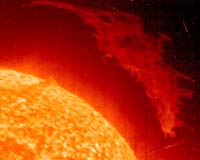
Palo Alto CA (SPX) Jul 29, 2004 Solar physicists from Lockheed Martin and the Solar Physics and upper-Atmosphere Research Group at the Department of Applied Mathematics of the University of Sheffield, UK have used computer modeling and some of the highest resolution images ever taken of the solar atmosphere to explain the cause of supersonic jets that continuously shoot through the low atmosphere of the Sun. Their results, which appear as the cover story in tomorrow's issue of the journal Nature, directly address the origin of these jets, called spicules. The origin of spicules has been a mystery since their discovery in 1877. These findings may well lead to a better understanding of how matter is propelled upward into the solar corona to form the solar wind, a stream of particles continuously emitted by the Sun that sweeps past Earth's orbit. Disturbances in the solar wind can influence the upper atmosphere and space environment around the Earth and damage satellites in orbit. "The combination of computer modeling, new high resolution images taken with the Swedish 1-meter Solar Telescope (SST) on the island of La Palma, Spain and data taken simultaneously with two satellites in space, was crucial to figure out how spicules are formed," said Dr. Bart De Pontieu, one of the main investigators on the study, and solar physicist at the Lockheed Martin Solar and Astrophysics Lab (LMSAL) at the company's Advanced Technology Center in Palo Alto, Calif. "We used a computer model to provide the missing link between observations of the surface of the Sun, taken with the MDI instrument onboard ESA/NASA's Solar and Heliospheric Observatory (SOHO) satellite, and observations of the jets in the low solar atmosphere taken with the SST and NASA's Transition Region and Coronal Explorer (TRACE) satellite." Spicules are jets of gas or plasma propelled upwards from the surface of the Sun. They shoot into its atmosphere or corona at supersonic speeds of about 50,000 miles per hour, and reach heights of 3,000 miles above the solar surface in less than five minutes. Although there are over 100,000 spicules at any time in the Sun's low atmosphere, or chromosphere, they remain largely unexplained, in part because observations are difficult for objects with so brief a lifetime (about five minutes) and relatively small size (300 miles diameter). "By simultaneously taking a series of high resolution images with the Swedish Solar Telescope, showing details down to 80 miles, and with the TRACE satellite, we discovered that these jets often occur periodically, usually every five minutes or so, at the same location," said Professor Robertus Erdelyi von Fay-Siebenburgen, the other main investigator on the study, and professor in applied mathematics at the Solar Physics and upper-Atmosphere Research Group of the University of Sheffield, UK. "We developed a computer model of the Sun's atmosphere to show that the periodicity of the spicules is caused by sound waves at the solar surface that have the same five minute period." The sound waves at the solar surface are usually damped before they can reach the Sun's atmosphere. However, De Pontieu, Erdelyi and Stewart James, a newly graduated Ph.D. under the supervision of Professor Erdelyi at the University of Sheffield, found that under certain conditions, the sound waves can penetrate through the damping zone and leak into the solar atmosphere. Their computer model shows that after the sound waves leak into the atmosphere, they develop into shock waves that propel matter upwards, forming a spicule. De Pontieu and his colleagues measured actual waves and oscillations at the surface of the Sun, using these measurements to drive their computer model of the solar atmosphere, which then predicted when jets of gas should shoot up. They were pleasantly surprised to see that the model predicts very accurately when jets should be observed on the Sun with the SST and TRACE. "Spicules carry more than 100 times the mass into the Sun's atmosphere required to feed the solar wind," said De Pontieu, "which means that they are of huge importance for the balance of how much mass goes into and out of the corona." With the origins of spicules revealed, it will be possible to study whether the mass that spicules carry into the solar corona contributes to the solar wind. Future studies will also focus on the role the shock waves may play in the higher solar atmosphere or corona. The results of this study are in a paper published in the journal Nature. The authors are Dr. Bart De Pontieu of Lockheed Martin Solar and Astrophysics Lab, and Professor Robertus Erdelyi von Fay-Siebenburgen and Dr. Stewart James of The Solar Physics and upper-Atmosphere Research Group at the Department of Applied Mathematics, University of Sheffield, UK. Community Email This Article Comment On This Article Related Links University of Sheffield SpaceDaily Search SpaceDaily Subscribe To SpaceDaily Express Solar Science News at SpaceDaily
 Twin APL-Built Solar Probes Shipped To NASA Goddard For Pre-Launch Tests
 Greenbelt MD (SPX) Nov 10, 2005
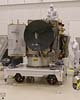
The first spacecraft designed to capture 3-D "stereo" views of the sun and solar wind were shipped Wednesday from the Johns Hopkins University Applied Physics Laboratory to NASA Goddard Space Flight Center for their next round of pre-launch tests. |
|
|

| The content herein, unless otherwise known to be public domain, are Copyright 1995-2006 - SpaceDaily.AFP and UPI Wire Stories are copyright Agence France-Presse and United Press International. ESA PortalReports are copyright European Space Agency. All NASA sourced material is public domain. Additionalcopyrights may apply in whole or part to other bona fide parties. Advertising does not imply endorsement,agreement or approval of any opinions, statements or information provided by SpaceDaily on any Web page published or hosted by SpaceDaily. Privacy Statement |