|
 |
 |
 |
 |
 |
 |
 |
 |

 |
Scientists Discover Tenth Planet
Los Angeles CA (AFP) Jul 30, 2005 A US astronomer said Friday he had discovered a 10th planet in the outer reaches of the solar system that could force a redrawing the astronomical map. If confirmed, the discovery by Mike Brown of the respected California Institute of Technology would be the first of a planet since Pluto was identified in 1930 and shatter the notion that nine planets circle the sun. "Get out your pens. Start re-writing textbooks today," said Brown, a professor of planetary astronomy, announcing what he called "the 10th planet of the solar system," one that is larger than Pluto. "It's the farthest object ever discovered to orbit around the sun," Brown said in a conference call of the planet that is covered in methane ice and lies nearly 15 billion kilometers (nine billion miles) from Earth. "I'd say it's probably one and a half times the size of Pluto," he said from CalTech, based in Pasadena, near Los Angeles, referring to what until now has been the most distant planet in earth's solar system. Currently about 97 times further from the sun than the Earth, the celestial body tentatively called "2003-UB313" is the farthest known object in the solar system, and the third brightest of the Kuiper belt objects. It is a typical member of the Kuiper belt, but its sheer size in relation to the nine known planets means that it can only be classified as a planet, Brown said. The astronomer conceded he and his team did not know the exact size of the new planet, but its brightness and distance tell them that it is at least as large as Pluto, which measures 2,302 kilometers (1,438 miles) in diameter. The size of an object in the solar system object can be inferred by its brightness, just as the size of a faraway light bulb can be calculated if one knows its wattage, he explained. "We are 100 percent confident that this is the first object bigger than Pluto ever found in the outer solar system." But Brown conceded that the discovery would likely rekindle debate over the definition of the term "planet" and whether Pluto should still be regarded as one. Critics have long questioned whether Pluto, which resembles objects in the Kuiper belt, is actually a planet. Brown discovered what could be a new addition to the universe known to man along with colleagues Chad Trujillo, of the Gemini Observatory in Mauna Kea, Hawaii, and David Rabinowitz, of Yale University, on January 8. The planet was first spotted on October 31, 2003 with the Samuel Oschin Telescope at Palomar Observatory near San Diego, California. But it was so far away that its motion was not detected until the scientists reanalysed the data earlier this year, Brown said. The astronomers have proposed a name for the "planet" to the science's governing body, the International Astronomical Union, and are awaiting the decision of this body before announcing it. The planet has not been noticed previously because its orbit is at a 45 degree angle to the rest of the solar system, he said. "We found it because we've looked everywhere else. Nobody looks way up that high. It's tilted way out of plane," he added. The new planet, which Brown said looks very much like Pluto, will be visible over the next six months and is currently almost directly overhead in the early-morning eastern sky, in the Cetus constellation. News of the discovery was announced earlier than expected after hackers broke into Brown's website and stole news of it, he charged. The team had planned to keep the news secret until their research was completed, but a Spanish team said Thursday it had identified a large, bright object in the Kuiper belt surrounding the solar system. Brown said "somebody with more cleverness than scruples" had uncovered what had been under wraps: that astronomers had discovered 2003-UB313 as well as another bright object in the Kuiper belt, forcing a public announcement. The announcement, resulting from a study partially funded by NASA, ironically came two days after the US space agency grounded its space shuttle fleet, after a piece of foam insulation broke off a fuel tank of the Discovery on lift-off earlier this week. The same problem led to the disintegration of the last shuttle to blast into space in 2003, killing seven astronauts.
Community Email This Article Comment On This Article Related Links Planet X at NASA SpaceDaily Search SpaceDaily Subscribe To SpaceDaily Express The million outer planets of a star called Sol
 Scientists Show Pluto To Be Colder Than It Should Be
 Cambridge MA (SPX) Jan 5, 2006
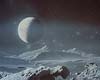
Mercury is boiling. Mars is freezing. The Earth is just right. When it comes to the temperatures of the planets, it makes sense that they should get colder the farther away they are from the Sun. But then there is Pluto. It has been suspected that this remote world might be even colder than it should be. Smithsonian scientists now have shown this to be true. |
|
|

| The content herein, unless otherwise known to be public domain, are Copyright 1995-2006 - SpaceDaily.AFP and UPI Wire Stories are copyright Agence France-Presse and United Press International. ESA PortalReports are copyright European Space Agency. All NASA sourced material is public domain. Additionalcopyrights may apply in whole or part to other bona fide parties. Advertising does not imply endorsement,agreement or approval of any opinions, statements or information provided by SpaceDaily on any Web page published or hosted by SpaceDaily. Privacy Statement |