|
 |
 |
 |
 |
 |
 |
 |
 |

 |
Scientists Discover Pluto Kin Is A Member Of Saturn Family
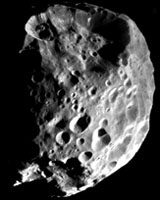
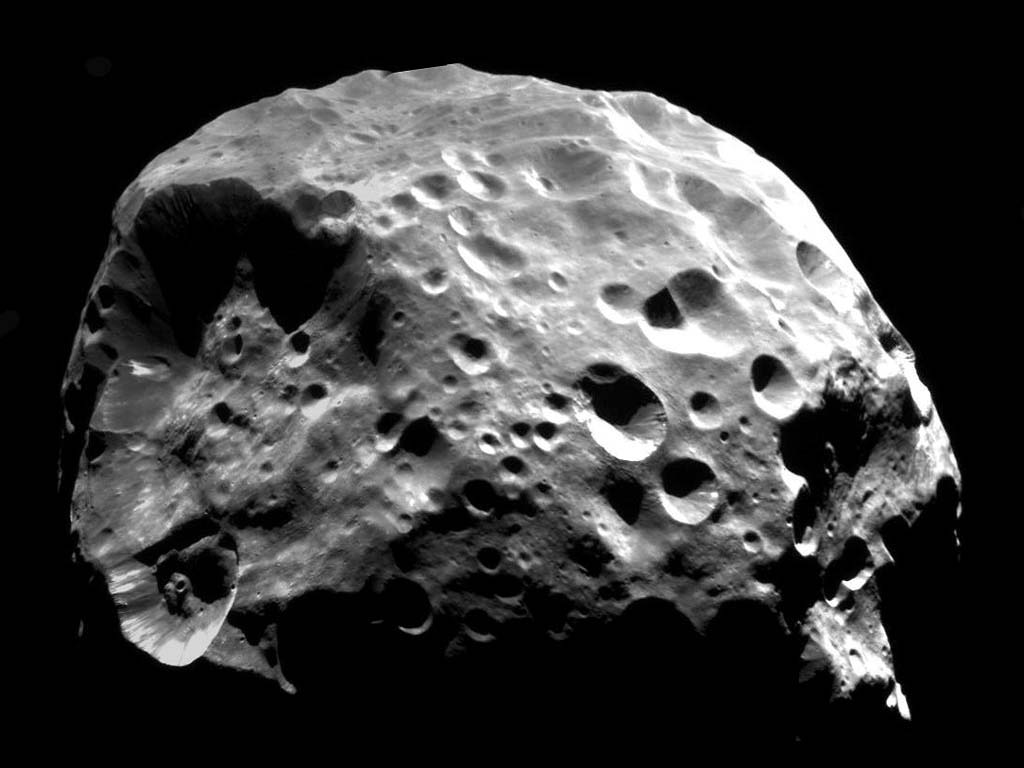
Pasadena CA (JPL) May 09, 2005 Saturn's battered little moon Phoebe is an interloper to the Saturn system from the deep outer solar system, scientists have concluded. The new findings appear in the May 5 issue of the journal Nature. "Phoebe was left behind from the solar nebula, the cloud of interstellar gas and dust from which the planets formed," said Dr. Torrence Johnson, Cassini imaging team member at NASA�s Jet Propulsion Laboratory, Pasadena, Calif. "It did not form at Saturn. It was captured by Saturn's gravitational field and has been waiting eons for Cassini to come along." Cassini flew by Phoebe on its way to Saturn on June 11, 2004. Little was known about Phoebe at that time. During the encounter, scientists got the first detailed look at Phoebe, which allowed them to determine its makeup and mass. With the new information they have concluded that it has an outer solar system origin, akin to Pluto and other members of the Kuiper Belt. "Cassini is showing us that Phoebe is quite different from Saturn's other icy satellites, not just in its orbit but in the relative proportions of rock and ice. "It resembles Pluto in this regard much more than it does the other Saturnian satellites," said Dr. Jonathan Lunine, Cassini interdisciplinary scientist from the University of Arizona, Tucson. Phoebe has a density consistent with that of the only Kuiper Belt objects for which densities are known. Phoebe�s mass, combined with an accurate volume estimate from images, yields a density of about 1.6 grams per cubic centimeter (100 pounds per cubic foot), much lighter than most rocks but heavier than pure ice, which is about 0.93 grams per cubic centimeter (58 pounds per cubic foot). This suggests a composition of ice and rock similar to that of Pluto and Neptune's moon Triton. Whether the dark material on other moons of Saturn is the same primordial material as on Phoebe remains to be seen. Community Email This Article Comment On This Article Related Links Cassini-Huygens at JPL Cassini Imaging Team SpaceDaily Search SpaceDaily Subscribe To SpaceDaily Express Explore The Ring World of Saturn and her moons Jupiter and its Moons The million outer planets of a star called Sol News Flash at Mercury
 Cassini Images Halo Around Titanic Moon Off Saturn
 Pasadena CA (SPX) Dec 27, 2005
With its thick, distended atmosphere, Titan's orange globe shines softly, encircled by a thin halo of purple light-scattering haze. |
|
|

| The content herein, unless otherwise known to be public domain, are Copyright 1995-2006 - SpaceDaily.AFP and UPI Wire Stories are copyright Agence France-Presse and United Press International. ESA PortalReports are copyright European Space Agency. All NASA sourced material is public domain. Additionalcopyrights may apply in whole or part to other bona fide parties. Advertising does not imply endorsement,agreement or approval of any opinions, statements or information provided by SpaceDaily on any Web page published or hosted by SpaceDaily. Privacy Statement |