|
 |
 |
 |
 |
 |
 |
 |
 |

 |
Scientists Diagnose Ozone Layer Status
Concordia Base (AFP) Antarctica, Feb 15, 2007 Like bedside doctors huddled in consultation, scientists gather in the bone-cracking cold of Antarctica to examine, several times a day, a very sick patient -- the ozone layer. Roman Cormic, a researcher in atmospheric physics at Jussieu, France's top university for science, probes with a gizmo called a light detection and ranging machine. "My mission," he explains at the Franco-Italian research station Concordia, perched atop the Antarctic Plateau some three kilometers (two miles) above sea level, "is to measure the ozone, as well as the density of the stratospheric clouds and the presence of chlorine." Florence Goutail, an engineer in the same field at France's National Centre for Scientific Research (CNRS), is in charge of setting up and monitoring a specially-designed spectrometer that measures ultraviolet waves from high-floating balloons. The collective diagnosis is unambiguous: the stratospheric blanket of oxygen molecules, some 15-35 kilometers (nine-21 miles) above Earth's surface, which protects human skin and eyes and plant DNA from dangerous ultraviolet light is ulcerated. It is being split apart by a hole that gapes open and narrows with the seasons. In October 2006 the ozone layer's wound spanned a record 29.5 million square kilometers (10.81 million square miles) and showed a loss of 40 million tonnes, exceeding the previous record of 39 million tonnes set in 2000, according to the European Space Agency (ESA). The primary cause of illness is known too. Over the second half of the 20th century, human activity excreted a corrosive soup of man-made chemicals -- especially chlorine and chlorofluorocarbons (CFCs) -- that breaks down the oxygen molecules in the stratosphere. The chemical reaction that thins ozone reaches its peak with colder high-altitude temperatures in the southern hemisphere winter, which is why the Antarctic skies are more vulnerable than anywhere else above Earth. Something called the polar vortex -- a persistent, cyclone-like weather pattern located near both poles -- makes the condition even worse. CFCs -- mainly aerosol gases and refrigerants -- and other ozone destroyers were belatedly controlled by an international treaty, the Montreal Protocol signed on September 16, 1987. But there is already so much of the pollution in the atmosphere, and some of the culprit chemicals take as long as 80 years to degrade, that large ozone holes are expected to persist for decades. And what prognosis for the patient? "I am not pessimistic for the time being," says Jean-Pierre Pommereau, research director at the CNRS's department of atmospherics physics in Verrieres-le-Buisson. Like living organisms, he suggests, the ozone layer will heal itself if given the chance. Barring a string of extremely cold winters, the ozone depletion will stop and fully reverse itself, returning to normal sometime around 2065, the World Meteorological Organization (WMO) and the UN Environment Programme (UNEP) said last year. The ozone level globally has lowered by 0.3 percent a year over the past decade. In the stratosphere, ozone is protective. At ground level, however, it is a pollutant -- created by a chemical reaction between exhaust fumes and sunlight -- that can be dangerous for people with bad respiratory or heart problems.
Source: Agence France-Presse Community Email This Article Comment On This Article Related Links All about the Ozone Layer All about the Ozone Layer
 Study Shows Extreme Contrast In Ozone Losses At North And South Poles
 Chicago (AFP) Dec 25, 2006
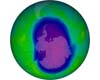
A study released Monday shows just how dramatic the ozone loss in the Antarctic has been over the past 20 years compared to the same phenomenon in the Arctic. The study found "massive" and "widespread" localized ozone depletion in the heart of Antartica's ozone hole region, beginning in the late 1970s, but becoming more pronounced in the 1980s and 90s. |
|
|

| The content herein, unless otherwise known to be public domain, are Copyright 1995-2006 - SpaceDaily.AFP and UPI Wire Stories are copyright Agence France-Presse and United Press International. ESA PortalReports are copyright European Space Agency. All NASA sourced material is public domain. Additionalcopyrights may apply in whole or part to other bona fide parties. Advertising does not imply endorsement,agreement or approval of any opinions, statements or information provided by SpaceDaily on any Web page published or hosted by SpaceDaily. Privacy Statement |