|
 |
 |
 |
 |
 |
 |
 |
 |

 |
Scientists Describe New Way To Peer Inside Bacteria
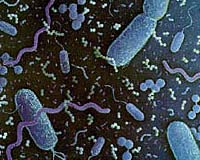
Upton NY (SPX) Aug 30, 2005 As part of the search for better ways to track and clean up soil contaminants, scientists at the U.S. Department of Energy's Brookhaven National Laboratory and Stony Brook University have developed a new way to "image" the internal chemistry of bacteria. The technique will allow scientists to "see" at the molecular level how soil-dwelling microbes interact with various pollutants. The method might also help scientists better understand and prevent bacterial diseases, or find ways to detect or disable bacteria used in a terror attack. "The more we learn about soil microbe chemistry, the better we'll be able to predict the movement of contaminants in the environment," said Brookhaven microbiologist Jeffrey Gillow. "What we learn might also suggest new ways to harness microorganisms to immobilize things like heavy metals and radioactive contaminants," he said. Gillow will give a talk on the new method at the 230th national meeting of the American Chemical Society in Washington, D.C. on Monday, August 29, 2005 at 11:10 a.m. in room 204C of the Washington Convention Center. Called x-ray spectromicroscopy, the method uses the extremely bright x-rays available at Brookhaven's National Synchrotron Light Source (NSLS) -- but not just to take pictures. At the NSLS, the scientists can actually "tune" the energy level of the beam to measure subtle differences in the energy absorbed by different forms of carbon. This carbon absorption spectrum, or "fingerprint," reveals detailed biochemical information about what is inside and around the bacterial cells -- and can even detect the formation of bacterial spores at an early stage invisible to other methods. "We are starting to learn a lot more about the molecular chemistry of these bacteria," said Gillow. "The goal is to understand better how they interact with metals and radionuclides." The technique may also reveal details about the process of bacterial spore formation. This could be important to environmental cleanup because spore-forming microbes often live in contaminated environments. It might also offer new targets for the detection of weaponized bacteria (by finding spores at an early stage), or help thwart disease or a terrorist attack by finding ways to prevent the spores from germinating into active, infective bacterial cells. With this technique, Gillow added, samples can be studied wet or dry, without staining, sectioning, or any other intervention such as those used in electron and fluorescence microscopy. Community Email This Article Comment On This Article Related Links SpaceDaily Search SpaceDaily Subscribe To SpaceDaily Express Darwin Today At TerraDaily.com
 Panda Paparrazi Swoons Over Cub Tai Shan At Washington Zoo
 Washington (AFP) Nov 29, 2005
There was 'panda-monium' at Washington's National Zoo on Tuesday as fluffy giant panda cub Tai Shan cavorted for the cameras, in his first encounter with the media pack. |
|
|

| The content herein, unless otherwise known to be public domain, are Copyright 1995-2006 - SpaceDaily.AFP and UPI Wire Stories are copyright Agence France-Presse and United Press International. ESA PortalReports are copyright European Space Agency. All NASA sourced material is public domain. Additionalcopyrights may apply in whole or part to other bona fide parties. Advertising does not imply endorsement,agreement or approval of any opinions, statements or information provided by SpaceDaily on any Web page published or hosted by SpaceDaily. Privacy Statement |