|
 |
 |
 |
 |
 |
 |
 |
 |

 |
Scientists Create New Form Of Matter: A Fermionic Condensate
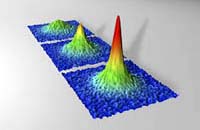
Boulder - Jan 29, 2004 Scientists at JILA, a joint laboratory of the Department of Commerce's National Institute of Standards and Technology (NIST) and the University of Colorado at Boulder (CU-Boulder) report the first observation of a "fermionic condensate" formed from pairs of atoms in a gas, a long-sought, novel form of matter. Physicists hope that further research with such condensates eventually will help unlock the mysteries of high-temperature superconductivity, a phenomenon with the potential to improve energy efficiency dramatically across a broad range of applications. The research is described in a paper to be published in the Jan. 24-30 online edition of Physical Review Letters by JILA authors Deborah S. Jin, a physicist at NIST and an adjoint associate professor at CU-Boulder, and Markus Greiner and Cindy Regal, a post-doctoral researcher and graduate student at CU-Boulder. (Expected publication date is Jan. 28, 2004.) "The strength of pairing in our fermionic condensate, adjusted for mass and density," Jin explains, "would correspond to a room temperature superconductor. This makes me optimistic that the fundamental physics we learn through fermionic condensates will eventually help others design more practical superconducting materials." The new work complements a previous major achievement, creation of a "Bose-Einstein" condensate, which earned JILA scientists Eric Cornell and Carl Wieman, the Nobel Prize in Physics in 2001. Bose-Einstein condensates are collections of thousands of ultracold particles occupying a single quantum state, that is, all the atoms are behaving identically like a single, huge superatom. Bose-Einstein condensates are made with bosons, a class of particles that are inherently gregarious; they'd rather adopt their neighbor's motion than go it alone. Unlike bosons, fermions--the other half of the particle family tree and the basic building blocks of matter--are inherently loners. By definition, no fermion can be in exactly the same state as another fermion. Consequently, to a physicist even the term--fermionic condensate--is almost an oxymoron. For many decades, physicists have proposed that superconductivity (which involves fermions) and Bose-Einstein condensates (BEC) are closely linked. Theorists have hypothesized that superconductivity and BEC are two extremes of superfluid behavior, an unusual state where matter shows no resistance to flow. Superfluid liquid helium, for example, when poured into the center of an open container, will spontaneously flow up and over the sides of the container. In the current experiment, a gas of 500,000 potassium atoms was cooled to temperatures below 50 billionths of a degree Celsius above absolute zero (minus 459 degrees Fahrenheit) and then a magnetic field was applied near a special "resonance" strength. This magnetic field coaxed the fermion atoms to match up into pairs, akin to the pairs of electrons that produce superconductivity, the phenomenon in which electricity flows with no resistance. The Jin group detected this pairing and the formation of a fermionic condensate for the first time on Dec. 16, 2003. The temperature at which metals or alloys become superconductors depends on the strength of the "pairing" interaction between their electrons. The highest known temperature at which superconductivity occurs in any material is about minus 135 degrees Celsius (minus 216 degrees Fahrenheit).
History Of Fermionic Condensate Research The experiments conducted by Jin's team appear to confirm these predictions. "We expect that the fermionic condensates that we observed," notes Jin, "will exhibit superfluid behavior. They represent a novel phase that lies in the crossover between superconductors and BEC." In November 2003, Jin's team (as well as a separate research group in Innsbruck, Austria) reported producing a Bose-Einstein condensate of molecules. In those experiments, a time-varying magnetic field was applied to fermionic atoms that forced them to combine into bosonic molecules. Fermions have half-integer "spins" (1/2, 3/2, 5/2, etc.), while bosons have integer "spins" (1, 2, 3, etc.). Spins are additive, so that a molecule containing two fermionic atoms is a boson. However, even if two fermions are not bound into one molecule, but merely move together in a correlated fashion, then as a pair they can act like a boson, and undergo condensation. It is this second, more subtle form of condensation that has been observed in the current experiments. The current work was performed by applying a particular magnetic field at values where individual fermionic atoms cannot bind together to form bosonic molecules. Instead, pairing of fermions is caused by the collective behavior of many atoms, similar to what causes "Cooper pairs" of electrons to form in a superconductor. Paradoxically, in order to detect that the experiment produced a condensate from paired fermions (and not molecules), the researchers had to first convert the pairs into molecules. A magnetic field at the right strength for molecular bonding was rapidly applied to the fermionic condensate and simultaneously the optical "trap" holding the gas was opened. This magnetic field change can create molecules, but was too fast to create a molecular BEC, as previously shown. Nonetheless, a "picture" of the molecules' motion showed the characteristic shape of a condensate cloud. "It happens too fast for anything to move around," says Jin. "The condensate that appears in our 'snapshot' of the gas has to have existed before the molecules were formed." In simple terms, the fermion pairs are like high-schoolers at a dance. When the band plays fast music, many dancers pair up and move together in a coordinated way. If the band suddenly switches to a slow dance, the dancers in each pair move closer and "bond." If a flash photograph is then taken immediately, the 'snapshot' will show "bound" dancers (molecules), but the arrangement of those dancers was determined earlier when the pairs first matched up. "Even in this first observation we were able to see the fermionic atom condensates in a much more direct way than anyone had anticipated," says Jin. "This opens up the very exciting potential to study superconductivity and superfluid phenomena under extreme conditions that have never existed before." Community Email This Article Comment On This Article Related Links National Institute of Standards and Technology at Boulder SpaceDaily Search SpaceDaily Subscribe To SpaceDaily Express Space Technology News - Applications and Research
 NGC Chosen To Proceed With Developing Solid-State Laser Technology For Military Applications
 Redondo Beach CA (SPX) Jan 09, 2006
Northrop Grumman Corporation has been selected to develop "military-grade," solid-state laser technology that is expected to pave the way for the U.S. military to incorporate high-energy laser systems across all services, including ships, manned and unmanned aircraft, and ground vehicles. |
|
|

| The content herein, unless otherwise known to be public domain, are Copyright 1995-2006 - SpaceDaily.AFP and UPI Wire Stories are copyright Agence France-Presse and United Press International. ESA PortalReports are copyright European Space Agency. All NASA sourced material is public domain. Additionalcopyrights may apply in whole or part to other bona fide parties. Advertising does not imply endorsement,agreement or approval of any opinions, statements or information provided by SpaceDaily on any Web page published or hosted by SpaceDaily. Privacy Statement |