|
 |
 |
 |
 |
 |
 |
 |
 |

 |
Scientists Confirm Earth's Energy Is Out Of Balance
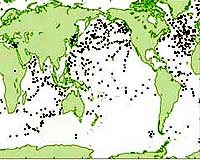
Washington DC (SPX) Apr 28, 2005 Using satellites, data from buoys and computer models to study the Earth's oceans, scientists have concluded that more energy is being absorbed from the Sun than is emitted back to space, throwing the Earth's energy "out of balance" and warming the planet. Scientists from the National Aeronautics and Space Administration (NASA) (Washington, D.C.), The Earth Institute at Columbia University (New York), and Lawrence Berkeley National Laboratory (California) have confirmed the energy imbalance by precisely measuring ocean heat content occurring over the past decade. The study, which appears in this week's Science Express, a feature of Science magazine, reveals that Earth's current energy imbalance is large by standards of Earth's history. The current imbalance is 0.85 watts per meter squared (W/m2) and will cause an additional warming of 0.6 degrees Celsius (1 degree Fahrenheit) by the end of this century. This is equal to a 1-watt light bulb shining over an area of one square meter or 10.76 square feet. Although seemingly small, this amount of heat affecting the entire world would make a significant impact. To put this number in perspective, an imbalance of 1 W/m2 maintained for the last 10,000 years is enough to melt ice equivalent to 1 kilometer (6/10ths of a mile) of sea level. The Earth's energy imbalance is an expected consequence of increasing atmospheric pollution, especially carbon dioxide (CO2), methane (CH4), ozone (O3), and black carbon particles (soot). These pollutants block the Earth's radiant heat from escaping into space, increasing absorption of sunlight and trapping heat within the atmosphere. "This energy imbalance is the 'smoking gun' that we have been looking for," says James Hansen, director of NASA's Goddard Institute for Space Studies, part of The Earth Institute at Columbia University, and the lead author of the study. "It shows that our estimates of the human-made and natural climate forcing agents are about right, and they are driving the Earth toward a warmer climate." Scientists know that increased radiation takes longer to manifest in the world's oceans longer than it does on land; the ocean, instead of showing an immediate temperature increase, holds the heat in storage within its depths, thus delaying a response to human-induced, or anthropogenic, climate change. The ocean's delayed response is similar to what happens during the summer months, when the ocean takes longer to warm up than do land surfaces. The building heat within the ocean's depths is what is known as "thermal inertia." The lag in the ocean's response has practical consequences. For one thing, it means that there is an additional global warming of about 1 degree Fahrenheit that is already "in the pipeline," and has not yet manifested in overall ambient temperatures. Even if there were no further increase of human-induced gases in the air, climate would continue to warm about that much over the next century. The lag in the climate response is both a boon and a problem for policy-makers. The delayed response of thermal inertia provides an opportunity to reduce the magnitude of human-made climate change before it is fully realized, provided that actions to reduce climate forcing agents are undertaken. On the other hand, if the world decides to wait for more overwhelming evidence of climate change, thermal inertia implies that still greater climate change will be in store, which may be difficult or impossible to avoid. Warmer water temperatures around the world may also lead to other significant climate-related consequences. "Warmer waters increase the likelihood of accelerated ice sheet disintegration and sea level rise during this century," Hansen said. Since 1993, data from satellite altimeters, used to measure sea level, have shown that the world's oceans have risen by 3.2 centimeters (cm), or 1.26 inches, per decade (plus or minus 0.4 cm). Although 3.2 cm may appear to be only a slight increase, it is twice as large as sea level rise in the last century. "There are positive feedbacks that come into play as the area of ice melt increases," says Hansen, "so we need to monitor the ice sheets and sea level precisely to be sure that the system is not running out of our control." Community Email This Article Comment On This Article Related Links SpaceDaily Search SpaceDaily Subscribe To SpaceDaily Express Climate Science News - Modeling, Mitigation Adaptation
 The Forgotten Methane Source
 Heidelberg, Germany (SPX) Jan 11, 2006
In the last few years, more and more research has focused on the biosphere; particularly, on how gases which influence the climate are exchanged between the biosphere and atmosphere. Researchers from the Max Planck Institute for Nuclear Physics have now carefully analysed which organic gases are emitted from plants. |
|
|

| The content herein, unless otherwise known to be public domain, are Copyright 1995-2006 - SpaceDaily.AFP and UPI Wire Stories are copyright Agence France-Presse and United Press International. ESA PortalReports are copyright European Space Agency. All NASA sourced material is public domain. Additionalcopyrights may apply in whole or part to other bona fide parties. Advertising does not imply endorsement,agreement or approval of any opinions, statements or information provided by SpaceDaily on any Web page published or hosted by SpaceDaily. Privacy Statement |