|
 |
 |
 |
 |
 |
 |
 |
 |

 |
Scientists Coax Gold Particles To Emit Light For Viewing Single Nanoparticles
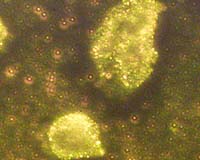
Chestnut Hill MA (SPX) May 31, 2005 Researchers in the laboratory of Boston College Chemistry Professor John T. Fourkas have demonstrated that gold particles comparable in size to a molecule can be induced to emit light so strongly that it is readily possible to observe a single nanoparticle. Fourkas, in collaboration with postdoctoral researcher Richard Farrer and BC undergraduates Francis Butterfield and Vincent Chen, coaxed the particles into strong emission of visible light using a technique called multiphoton absorption induced luminescence (MAIL). The most efficient gold nanoparticles could be observed at laser intensities lower than those commonly used for multiphoton imaging, in which specific tissues or cells - cancer cells, for example - are fluorescently-labeled using special stains that enable them to be studied. "One of the most exciting aspects of this technique is that it paves the way for being able to observe behavior in living tissues at the single molecule level," said Fourkas. "The fluorescent molecules commonly used in multiphoton imaging give out only a limited amount of light, 'burn out' quickly under continuous observation, and are prone to blinking on and off. "The gold particles, however, do not blink or burn out, even after hours of observation, and the brightest ones emit much more light than do molecules," he said. "We now have the ability to see single nanoparticles under conditions where people usually look at thousands or millions of stain molecules. This could allow us, for instance, to track a single molecule of a drug in a cell or other biological sample." Other advantages of the technique are that the gold particles can be prepared easily, have very low toxicity, and can readily be attached to molecules of biological interest, said Fourkas. In addition, the laser light used to visualize the particles is at a wavelength range that causes only minimal damage to most biological tissue. The findings will be published in the June issue of Nano Letters. Community Email This Article Comment On This Article Related Links Boston College SpaceDaily Search SpaceDaily Subscribe To SpaceDaily Express Nano Technology News From SpaceMart.com Computer Chip Architecture, Technology and Manufacture
 Prof Develops Cancer Nanobomb
 Newark DE (SPX) Oct 14, 2005
University of Delaware researchers are opening a new front in the war on cancer, bringing to bear new nanotechnologies for cancer detection and treatment and introducing a unique nanobomb that can literally blow up breast cancer tumors. |
|
|

| The content herein, unless otherwise known to be public domain, are Copyright 1995-2006 - SpaceDaily.AFP and UPI Wire Stories are copyright Agence France-Presse and United Press International. ESA PortalReports are copyright European Space Agency. All NASA sourced material is public domain. Additionalcopyrights may apply in whole or part to other bona fide parties. Advertising does not imply endorsement,agreement or approval of any opinions, statements or information provided by SpaceDaily on any Web page published or hosted by SpaceDaily. Privacy Statement |