|
 |
 |
 |
 |
 |
 |
 |
 |

 |
Scientists Can Predict Pulsar Starquakes
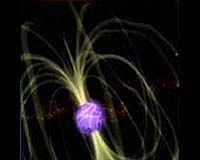
Calgary, Alberta (SPX) Jun 07, 2006 Scientists said Monday they have discovered how to predict earthquake-like events in pulsars, the dense remains of exploded stars. The violent episodes likely crack a pulsar's dense crust and momentarily bump up its spin rate. John Middleditch of Los Alamos National Laboratory in New Mexico led the team that discovered for one particular pulsar, named PSR J0537-6910, the time to the next quake is proportional to the size of the last quake. With this simple formula, the scientists have been able to aim NASA's Rossi X-ray Timing Explorer at the pulsar a few days before the quake to watch the event unfold. Using NASA's Rossi X-ray Timing Explorer, the team has tracked about 20 starquakes in this pulsar over the past eight years and uncovered a remarkably simple, predictive pattern. "By monitoring the pulsar spin rate and changes in the spin, we can pin down a starquake event to within a couple of days," Middleditch said. "These and other details have helped to simplify what has, until now, appeared to be a bewildering assemblage of facts about starquakes in pulsars. If only predicting earthquakes were this straightforward." Middleditch presented his findings at the 208th American Astronomical Society Meeting. Once several times more massive than the Sun, a pulsar contains about the same mass as the Sun compacted into a sphere only about 20 miles across. A pulsar is so dense that a teaspoon of its material would weigh 2 billion tons on Earth. The pulsar is so named because it appears to pulse with radiation from its two magnetic poles as it spins, sending two lighthouse-like beams through space. PSR J0537-6910 is located in a 4,000-year-old supernova remnant near the Milky Way, about 170,000 light-years from Earth, and visible in the Southern Hemisphere. The pulsar is known for its frequent quakes, which scientists call glitches. Pulsars are born spinning rapidly, but gradually slow down. PSR J0537-6910 spins at a rate of about 62 times per second, or 62 hertz. During a glitch, this pulsar's spin jumps up as much as one cycle every seven hours, a greater gain than what is seen in any other pulsar. Then the pulsar proceeds to slow down again. After about 10 glitches since monitoring began in 1999, the scientists saw a pattern. The amount of increase in spin with each glitch could be translated directly into the number of days until the next glitch. Larger glitches meant a longer wait until the next one. The predictive nature of these glitches firms up the leading theory on their cause. Pulsars have a solid crust, but are permeated with a liquid neutron superfluid. Much of the crust's own superfluid does not slow with the pulsar, but when the difference in rotation rates exceeds a certain threshold, a large fraction of the excess can be dumped into the solid crust through massive cracking, making the pulsar spin faster. The major glitch is always preceded by small ones, representing local dumps of rotation due to localized, small cracking. "A month ago we were watching the pulsar get the 'jitters' before the big quake," Middleditch said. "Then, by May 7th, the big one had happened. We can only predict one glitch at a time." Middleditch said his team also found evidence the pulsar's magnetic pole is moving a few feet every year. Although a known feature on Earth, this is the first strong case for magnetic pole migration on a pulsar. Community Email This Article Comment On This Article Related Links Rossi X-ray Timing Explorer Stellar Chemistry, The Universe And All Within It
 Astronomers Find Most Distant Galaxy Cluster Yet
 Calgary, Alberta (SPX) Jun 7, 2006
Astronomers have found the most distant cluster of galaxies to date and possibly the most massive one yet seen at such an early era in the universe. |
|
|

| The content herein, unless otherwise known to be public domain, are Copyright 1995-2006 - SpaceDaily.AFP and UPI Wire Stories are copyright Agence France-Presse and United Press International. ESA PortalReports are copyright European Space Agency. All NASA sourced material is public domain. Additionalcopyrights may apply in whole or part to other bona fide parties. Advertising does not imply endorsement,agreement or approval of any opinions, statements or information provided by SpaceDaily on any Web page published or hosted by SpaceDaily. Privacy Statement |