|
 |
 |
 |
 |
 |
 |
 |
 |

 |
Scientists Aim To Thwart Use Of Flu As Bioweapon
Rochester, New Yorkd (SPX) Jun 25, 2006 Flu is already a big killer, responsible for more than 35,000 deaths in the United States alone each year. And wild birds infected with the deadly H5N1 strain of bird flu are gradually broadening the scope of that disease. This week in Rochester, scientists are discussing ways to better understand the flu and also how to prevent the possibility that terrorists could somehow modify flu as a bioweapon to make it even more lethal than it is already. Among the highlights of this week's two-day symposium, hosted by the University of Rochester Center for Biodefense Immune Modeling, is a lecture by Nobel Prize winner Peter Doherty, Ph.D., an expert on how flu spurs the immune system to defend itself against the infection. Doherty's technical talk on the roles of specific types of T-cells in influenza will be at 1:30 p.m. Friday, June 23, at the Rochester Marriott Airport Hotel on West Ridge Road. The lecture is free and open to the public. During the symposium Thursday and Friday, University of Rochester experts in mathematics, statistics, immunology, and infectious diseases will join with colleagues from around the nation to discuss exactly how flu invades the body, how the body responds, and how mathematicians, statisticians, and computer scientists are working to help understand the pathogenesis of flu infection. The group will also talk about the potential of flu to be intentionally modified for use as a lethal weapon more deadly than bird flu, and ways to prevent that from happening. "Flu viruses are deadly - witness the 1918 Spanish flu which killed millions of people - and with modification, they can be made even more deadly," said Hulin Wu, Ph.D., professor in the Department of Biostatistics and Computational Biology and director of the modeling center. Wu's colleague, Martin Zand, M.D., Ph.D., co-director of the center, added that "We don't know whether flu will be weaponized; it's crucial to ask the question and to be prepared." The focus of Wu's center, funded by the National Institutes of Health, is the mathematical modeling of infectious diseases. When the flu virus infects the body, for instance, a cascade of complex events occur to fight the virus as it commandeers cells and begins churning out viral particles that attack the body. The immune system falls back on an array of cells, especially antibody-producing B-cells and flu-killing T cells, to fight back. Understanding just how that occurs, and simulating that with computers, is the goal of the center. Wu points to the improved treatment of HIV as an area where such an approach has already yielded enormous benefit to patients. Once considered a death sentence, HIV infection is now more commonly viewed as a chronic infection thanks largely to improved treatment. Much of the improvement is due to early mathematical models that helped scientists and physicians understand and target the disease more effectively. "How flu infects the body and how the body responds to a flu infection is not understood completely," said Wu. "Mathematical models will help guide flu experts to ask the right questions, so that we understand it more thoroughly than we do today. Understanding exactly what is happening should help scientists evaluate how the virus will respond to drugs designed to treat an infection." Since flu is already a killer, the discussions will have an immediate application among scientists looking for ways to stop or better treat "natural" flu. The work also helps scientists like John Treanor, M.D., and David Topham, Ph.D., who are designing and testing new vaccines designed to prevent all types of flu, including bird flu. The University is recognized internationally as a leader in the testing of bird-flu vaccines. "For many years people did not recognize the importance of flu research," said Topham, associate professor of Microbiology and Immunology and a scientist in the David H. Smith Center for Vaccine Biology and Immunology. "Flu research was seen as humdrum and routine, and there was no driving force to do that research. It just sort of blended into the background. People assumed that since there is a vaccine, it wasn't a disease of interest any more. "But with bird flu on the horizon and the vaccine shortages that have occurred in recent years, it's become a hotbed of research interest. Besides, flu is responsible for 35,000 deaths and 200,000 hospitalizations in the United States alone. It's a serious health problem," Topham added. Community Email This Article Comment On This Article Related Links University of Rochester Medical Center The Long War - Doctrine and Application
 Cyanide Gas Device Probably Would Not Have Worked Says Terror Experts
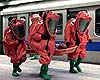 Washington (UPI) Jun 25, 2006
The device reportedly developed by al-Qaida to disperse deadly cyanide gas in subway cars and other confined spaces has never been used in a terrorist attack and probably would not be very effective, say experts. |
|
|

| The content herein, unless otherwise known to be public domain, are Copyright 1995-2006 - SpaceDaily.AFP and UPI Wire Stories are copyright Agence France-Presse and United Press International. ESA PortalReports are copyright European Space Agency. All NASA sourced material is public domain. Additionalcopyrights may apply in whole or part to other bona fide parties. Advertising does not imply endorsement,agreement or approval of any opinions, statements or information provided by SpaceDaily on any Web page published or hosted by SpaceDaily. Privacy Statement |