Scientists at the University of Sheffield have shown how bacteria could be used as a future fuel. The research, published in the journal Bioinformatics, could have significant implications for the environment and the way we produce sustainable fuels in the future.
Like all living creatures, bacteria sustain themselves through their metabolism, a huge sequence of chemical reactions that transform nutrients into energy and waste.
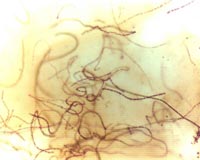
Using mathematical computer models, the Sheffield team have mapped the metabolism of a type of bacteria called Nostoc. Nostoc fixes nitrogen and, in doing so, releases hydrogen that can then potentially be used as fuel.
Fixing nitrogen is an energy intensive process and it wasn't entirely clear exactly how the bacterium produces the energy it needs in order to perform. Now the new computer system has been used to map out how this happens.
Until now, scientists have had difficulties identifying bacteria metabolic pathways. The bacterial metabolism is a huge network of chemical reactions, and even the most sophisticated techniques can only measure a small fraction of its activity.
Dr Guido Sanguinetti, from the University's Department of Computer Science, who led the study, said: "The research uncovered a previously unknown link between the energy machinery of the Nostoc bacterium and its core nitrogen metabolism.
Further investigation of this pathway might lead to understanding and improvement of the hydrogen production mechanism of these bacteria. It will certainly be some time before a pool of bacteria powers your car, but this research is yet another small step towards sustainable fuels."
He added: " The next step for us will be further investigation into hydrogen production, as well as constructing more mathematical models capable of integrating various sources of biological data."
 del.icio.us
 Digg
Digg Reddit
 YahooMyWeb
 Google
 Facebook