|
 |
 |
 |
 |
 |
 |
 |
 |

 |
Saturn's Uniquely Complex Magnetosphere
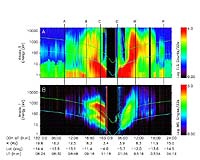
San Antonio TX (SPX) Feb 25, 2005 Since the two Voyager spacecraft sped past Saturn nearly 25 years ago, scientists have marveled at its giant magnetosphere and the plasma - a complex magnetized fluid of hot charged particles - confined within it. Plasma trapped around Earth is a comparatively simple mix of ingredients drawn exclusively from the solar wind and the Earth's atmosphere - our Moon contributes virtually nothing. In contrast, icy moons, rings, and the atmosphere of the giant moon Titan all contribute to Saturn's swirling plasma. Using new data from the Cassini mission, scientists are beginning to tease out the m�lange of ingredients and processes that contribute to the ringed planet's surprisingly complicated magnetosphere. "Saturn's magnetosphere is truly unique. It's dynamically similar to Jupiter's, but in places it chemically resembles water-based plasmas surrounding comets," said Dr. David Young, who cited new data published in the February 25 issue of the journal Science. Young, an Institute scientist in the Space Science and Engineering Division at Southwest Research Institute (SwRI), leads an international team of scientists working to decipher the processes under way in Saturn's magnetosphere. Using data gathered with the Cassini Plasma Spectrometer during the spacecraft's initial orbit around Saturn, the team identified four plasma regions distinguished by their chemical composition and fluid-like properties. Earth has two such regions, one dominated by plasma from the ionosphere and the other with plasma from the solar wind. Plasmas within about 15,000 miles of Earth rotate with it. Saturn's planetary rotation controls the flow of plasma out to nearly a million miles. Within that volume is Titan, the majority of the icy moons and the rings, all of which turn out to be strong suppliers of plasmas of varying compositions. "That is what makes Saturn's magnetosphere so different," said Young, who leads the CAPS team. "Saturn has three kinds of plasma sources that Earth doesn't have. In addition, these plasmas interact both chemically and electromagnetically. One of the consequences is that the surfaces of the icy moons and rings are re-coated by the chemical mix. Another is that some of Titan's atmosphere gets stolen. Earth's magnetosphere is pretty boring by comparison." Aided by solar ultraviolet energy, the plasma regenerates itself. Photons from the sun and electrons and ions from the plasma crash into the icy surfaces of the moons and rings. They strike with enough energy to knock free and ionize molecules such as water or even primordial nitrogen buried in the ice. The ionized material is then accelerated by Saturn's rapidly rotating magnetic field, repeating the cycle. Plasma that the team found trapped over the rings suggests an atmosphere made up of molecular oxygen, similar to the thin atmospheres of Jupiter's moons Europa and Ganymede. Farther out in the magnetosphere, plasma composed of water ions stripped from the icy moons resembles that found in the comas of comets. "The exotic combinations of chemistry and plasma dynamics are very different from our expectations," said Young. "We'll probably need all of Cassini's next 70 orbits to understand what's going on." SwRI researchers also participate on Cassini's Imaging Science Subsystem, Composite Infrared Spectrometer and Ion and Neutral Mass Spectrometer teams. Community Email This Article Comment On This Article Related Links Cassini-Huygens at JPL Cassini Imaging Team Southwest Research Institute SpaceDaily Search SpaceDaily Subscribe To SpaceDaily Express Explore The Ring World of Saturn and her moons Jupiter and its Moons The million outer planets of a star called Sol News Flash at Mercury
 Cassini Images Halo Around Titanic Moon Off Saturn
 Pasadena CA (SPX) Dec 27, 2005
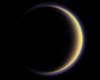
With its thick, distended atmosphere, Titan's orange globe shines softly, encircled by a thin halo of purple light-scattering haze. |
|
|

| The content herein, unless otherwise known to be public domain, are Copyright 1995-2006 - SpaceDaily.AFP and UPI Wire Stories are copyright Agence France-Presse and United Press International. ESA PortalReports are copyright European Space Agency. All NASA sourced material is public domain. Additionalcopyrights may apply in whole or part to other bona fide parties. Advertising does not imply endorsement,agreement or approval of any opinions, statements or information provided by SpaceDaily on any Web page published or hosted by SpaceDaily. Privacy Statement |