|
 |
 |
 |
 |
 |
 |
 |
 |

 |
Saturn's Radio Emissions Could Be Mistaken For A Halloween Sound Track
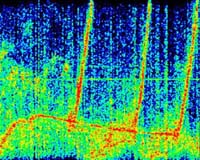
Pasadena CA (JPL) Jul 26, 2005 That's how two researchers describe their recent findings, published in the July 23 issue of the Geophysical Research Letters. Their paper is based on data from the Cassini spacecraft radio and plasma wave science instrument. The study investigates sounds that are not just eerie, but also descriptive of a phenomenon similar to Earth's northern lights. "All of the structures we observe in Saturn's radio spectrum are giving us clues about what might be going on in the source of the radio emissions above Saturn's auroras," said Dr. Bill Kurth, deputy principal investigator for the instrument. He is with the University of Iowa, Iowa City. Kurth made the discovery along with Principal Investigator Don Gurnett, a professor at the University. "We believe that the changing frequencies are related to tiny radio sources moving up and down along Saturn's magnetic field lines." The radio emissions, called Saturn kilometric radiation, are generated along with Saturn's auroras, or northern and southern lights. Because the Cassini instrument has higher resolution compared to a similar instrument on NASA's Voyager spacecraft, it has provided more detailed information on the spectrum and the variability of radio emissions. The high-resolution measurements allow scientists to convert the radio waves into audio recordings by shifting the frequencies down into the audio frequency range. The terrestrial cousins of Saturn's radio emissions were first reported in 1979 by Gurnett, who used an instrument on the International Sun-Earth Explorer spacecraft in Earth orbit. Kurth said that despite their best efforts, scientists still haven't agreed on a theory to fully explain the phenomenon. They will get another chance to solve the radio emission puzzle beginning in mid-2008 when Cassini will fly close to, or possibly even through, the source region at Saturn. Gurnett said, "It is amazing that the radio emissions from Earth and Saturn sound so similar." Other contributors to the paper include University of Iowa scientists George Hospodarsky and Baptiste Cecconi; Mike Kaiser (currently at Goddard Space Flight Center, Greenbelt, Md.); French scientists Philippe Louarn, Philippe Zarka and Alain Lecacheux; and Austrian scientists Helmut Rucker and Mohammed Boudjada. Community Email This Article Comment On This Article Related Links Sounds of Saturn Volume 1 Cassini-Huygens at JPL Cassini Imaging Team SpaceDaily Search SpaceDaily Subscribe To SpaceDaily Express Explore The Ring World of Saturn and her moons Jupiter and its Moons The million outer planets of a star called Sol News Flash at Mercury
 Cassini Images Halo Around Titanic Moon Off Saturn
 Pasadena CA (SPX) Dec 27, 2005
With its thick, distended atmosphere, Titan's orange globe shines softly, encircled by a thin halo of purple light-scattering haze. |
|
|

| The content herein, unless otherwise known to be public domain, are Copyright 1995-2006 - SpaceDaily.AFP and UPI Wire Stories are copyright Agence France-Presse and United Press International. ESA PortalReports are copyright European Space Agency. All NASA sourced material is public domain. Additionalcopyrights may apply in whole or part to other bona fide parties. Advertising does not imply endorsement,agreement or approval of any opinions, statements or information provided by SpaceDaily on any Web page published or hosted by SpaceDaily. Privacy Statement |