|
 |
 |
 |
 |
 |
 |
 |
 |

 |
Saturn's Perfect Storms
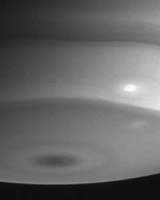
Moffett Field CA (SPX) Oct 11, 2004 Saturn is the windiest planet in the solar system, which is one mystery of the ringed giant. On Saturn the superstorms can produce thousand mph winds. Saturn storms brew in both the northern and southern hemispheres but take on their highest winds at the equator. The hurricanes on Saturn can begin with cloud masses nearly the size of the entire Earth. As the storms grow, it is not unusual for a single storm to grow to engulf the equivalent of thirty Earths. Storms at Saturn's equator move eastward at speeds up to 450 meters per second (1000 mph), which is about 10 times the speed of the Earth's jet streams and approximately three times greater than the equatorial winds on Jupiter. This image was taken with the Cassini spacecraft narrow angle camera on Sept. 10, 2004, at a distance of 8.8 million kilometers (5.5 million miles) from Saturn, through a filter sensitive to wavelengths of infrared light centered at 750 nanometers. The image scale is 52 kilometers (32 miles) per pixel. The image has been contrast enhanced to improve visibility of features in the atmosphere. When Earth storms hit land they begin to dissipate, but on Saturn a storm can circumnavigate the entire planet. During the thirty-year Saturnian summers, heated gases rise on the sunward facing hemisphere. These warmer layers eventually become unstable at higher altitudes and ammonia rich clouds eventually produce ice-crystals. Cassini's big adventure with Saturn's moon begins in earnest at the beginning of 2005, when the Huygens probe begins to descend to the surface of the largest moon Titan. European and American scientists hope to use Huygens to get a close-up view of what might provide analogies to what a very primordial Earth might have looked like, if it never progressed beyond an ice age. Just as Saturn seems like a miniature of our larger solar system, so too may its moons give a glimpse of what might have cooked up closer to the Sun than Saturn. Community Email This Article Comment On This Article Related Links SpaceDaily Search SpaceDaily Subscribe To SpaceDaily Express Explore The Ring World of Saturn and her moons Jupiter and its Moons The million outer planets of a star called Sol News Flash at Mercury
 Cassini Images Halo Around Titanic Moon Off Saturn
 Pasadena CA (SPX) Dec 27, 2005
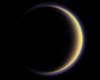
With its thick, distended atmosphere, Titan's orange globe shines softly, encircled by a thin halo of purple light-scattering haze. |
|
|

| The content herein, unless otherwise known to be public domain, are Copyright 1995-2006 - SpaceDaily.AFP and UPI Wire Stories are copyright Agence France-Presse and United Press International. ESA PortalReports are copyright European Space Agency. All NASA sourced material is public domain. Additionalcopyrights may apply in whole or part to other bona fide parties. Advertising does not imply endorsement,agreement or approval of any opinions, statements or information provided by SpaceDaily on any Web page published or hosted by SpaceDaily. Privacy Statement |