|
 |
 |
 |
 |
 |
 |
 |
 |

 |
Saturn's Immense Icy Cloud
Boulder CO (SPX) Jan 11, 2005 Ice particles are key players in the ever-changing panorama at Saturn, according to a new study led by a University of Colorado at Boulder professor using an instrument on the Cassini-Huygens spacecraft now at the ringed planet. Larry Esposito of the Laboratory for Atmospheric and Space Physics said data from the Ultraviolet Imaging Spectrometer, or UVIS, indicates much of Saturn's system is filled with ice, as well as atoms derived from water. Esposito is the principal investigator for the $12.5 million UVIS instrument riding on the craft. Esposito said hydrogen and oxygen atoms are widely distributed in the planetary system, which extends millions of miles outward from Saturn. Cassini researchers are seeing large fluctuations in the amount of oxygen in the Saturn system, he said. "A possible explanation for the fluctuation in oxygen is that small, unseen icy moons have been colliding with Saturn's E ring," said Esposito. "The collisions may have produced small grains of ice, which yielded oxygen atoms when struck by energetic, charged particles in Saturn's magnetosphere. UVIS is able to identify these glowing atoms." A paper on the subject authored by Esposito and colleagues appeared in the Dec. 16 issue of Science Express, the online version of Science magazine. Esposito also will give a presentation on the new results from the Cassini-Huygens mission at the Fall Meeting of the American Geophysical Union, in San Francisco. Saturn's ring particles may have formed originally from pure ice, Esposito said. But they have since been subjected to continual bombardment by meteorites, which has contaminated the ice and caused the rings to darken. Over time, incessant meteorite bombardment has likely spread the dirty material resulting from the collisions widely among the ring particles, he said. But instead of uniformly dark rings, the UVIS instrument is recording "radial variations" that show brighter and darker bands in the individual rings. "The evidence indicates that in the last 10 million to 100 million years, fresh material probably was added to the ring system," he said. The research team proposed that such "renewal events" are from the fragmentation of small moons, each probably about 20 kilometers (12 miles) across. "The interiors of the tiny moonlets, which have been shielded from contamination by the continual collisions with each other, are the source of purer water ice," he said. "Both the oxygen fluctuation and the spectral variation in Saturn's rings support a model of ring history in which small moons are continually destroyed to produce new rings." The ice grains released by the continual moonlet collisions are bathed by Saturn's radiation belt, liberating the oxygen atoms that are seen by UVIS in the ultraviolet as they reflect sunlight in the immense cloud surrounding Saturn, said Esposito. Around 1655, the Dutch scientist, Huygens first recognized that Saturn was "girdled by a thin, flat ring, nowhere touching it." The rings may be composed of icebergs and/or snowballs from a few centimeters to a few meters in size. As a milestone for marrying theoretical and observational astronomy, scientists predicted that an undiscovered ring might be formed here, and only in 1980 was their "F-ring" hypothesis confirmed by Voyager I during its Saturn flyby. The lettering scheme, "A through F", refers to the historical order of the ring divisions' discoveries, and does not relate easily to their distance from Saturn. In the case of the thin F and G rings, the last discovered gaps, these debris fields do lie outside the more prominent "A through D" system. Other authors on the Science Express paper include LASP's Joshua Colwell, Kristopher Larsen, William McClintock and Ian Stewart. Researchers from the University of Southern California, NASA's Jet Propulsion Laboratory, Central Arizona University, the California Institute of Technology and the Max Planck Institute and Stuttgart University in Germany also co-authored the paper. Community Email This Article Comment On This Article Related Links SpaceDaily Search SpaceDaily Subscribe To SpaceDaily Express Explore The Ring World of Saturn and her moons Jupiter and its Moons The million outer planets of a star called Sol News Flash at Mercury
 Cassini Images Halo Around Titanic Moon Off Saturn
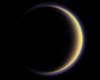 Pasadena CA (SPX) Dec 27, 2005
With its thick, distended atmosphere, Titan's orange globe shines softly, encircled by a thin halo of purple light-scattering haze. |
|
|

| The content herein, unless otherwise known to be public domain, are Copyright 1995-2006 - SpaceDaily.AFP and UPI Wire Stories are copyright Agence France-Presse and United Press International. ESA PortalReports are copyright European Space Agency. All NASA sourced material is public domain. Additionalcopyrights may apply in whole or part to other bona fide parties. Advertising does not imply endorsement,agreement or approval of any opinions, statements or information provided by SpaceDaily on any Web page published or hosted by SpaceDaily. Privacy Statement |