|
 |
 |
 |
 |
 |
 |
 |
 |

 |
Saturn moon shows potential for water and life: NASA
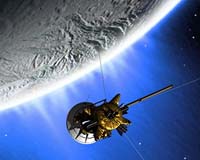
Washington (AFP) March 26, 2008 The Cassini spacecraft detected temperatures and organic materials indicating possible conditions for life on Saturn's moon Enceladus as it flew through giant plumes at the moon's south pole, NASA officials said Wednesday. The spacecraft found a high density of water vapor and both simple and complex organic chemicals as it passed within 50 kilometers (30 miles) of Enceladus on March 12 to assess the geyser-like plumes shooting out from surface fractures, the space agency said. Cassini's instruments detected temperatures on Enceladus's south pole hot-spot as high as minus 135 degrees F (minus 93 C), which suggested that sub-surface temperatures might be high enough for the existence of liquid water, one of the keys to possible life, John Spencer, one of the scientists on the Cassini team, told a news conference. "It means we have a great deal of energy being delivered to the surface in this region," said Spencer, who works on Cassini's composite infrared spectrometer team at the Southwest Research Institute in Boulder, Colorado. "It's entirely possible that there's going to be liquid water not too far below the surface of these fractures," he said. "We see on Enceladus the three basic ingredients for the origin of life" -- energy, organic compounds and water, said Larry Esposito of the University of Colorado, who works on Cassini's ultraviolet imaging spectrograph. Hunter Waite, another Cassini team scientist, said the spacecraft's instruments showed that composition of the plumes was much like that of most comets: "carbonated water with essence of natural gas." The fly-by found increasing density of water vapor as Cassini sped through the plumes at 51,500 kilometers (32,000 miles) per hour. The plumes also carried a large volume of ice particles picked up from the moon's surface as they blast from fissures in the surface. Also in the plumes, which feed into Saturn's E ring, were simple and complex organic materials like carbon monoxide and dioxide, methane, and propane, Waite said, a likely product of "geochemistry" in the moon's interior. "The question that one would ask is that, where did the organics come from?" he said. What Cassini found suggested Enceladus had significant astrobiological potential -- potential for life -- Waite said. "The organics are clearly there in the abundance beyond that we expected." The Enceladus fly-by was the first of four planned this year to investigate the massive plumes emanating from the unique hot region discovered by Cassini at the south pole of the 505 kilometer (314 mile) diameter moon in 2005. The Enceladus report came days after scientists said in a paper that Cassini had supplied evidence for the possible existence of a subsurface ocean of water and ammonia on Titan, Saturn's largest moon. "We believe that about 100 kilometers (62 miles) beneath the ice and organic-rich surface is an internal ocean of liquid water mixed with ammonia," said Bryan Stiles of NASA's Jet Propulsion Laboratory in Pasadena, California, and one of the authors of a paper on Titan in the March 21 issue of the journal Science. Community Email This Article Comment On This Article Related Links Explore The Ring World of Saturn and her moons Jupiter and its Moons The million outer planets of a star called Sol News Flash at Mercury
 Cassini Spacecraft To Dive Into Water Plume Of Saturn Moon
 Pasadena CA (SPX) Mar 11, 2008
NASA's Cassini spacecraft will make an unprecedented "in your face" flyby of Saturn's moon Enceladus on Wed., March 12. The spacecraft, orchestrating its closest approach to date, will skirt along the edges of huge Old-Faithful-like geysers erupting from giant fractures on the south pole of Enceladus. Cassini will sample scientifically valuable water-ice, dust and gas in the plume. |
|
|

| The content herein, unless otherwise known to be public domain, are Copyright 1995-2007 - SpaceDaily.AFP and UPI Wire Stories are copyright Agence France-Presse and United Press International. ESA Portal Reports are copyright European Space Agency. All NASA sourced material is public domain. Additional copyrights may apply in whole or part to other bona fide parties. Advertising does not imply endorsement,agreement or approval of any opinions, statements or information provided by SpaceDaily on any Web page published or hosted by SpaceDaily. Privacy Statement |