|
 |
 |
 |
 |
 |
 |
 |
 |

 |
Saturn Sightings: Tethys
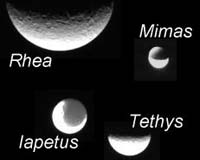
Moffett Field CA (SPX) Oct 11, 2004 Cassini sighted the far-off icy moon Tethys as it headed back toward Saturn in its long, looping first orbit of the planet. A faint hint of detail on the moon's cratered surface is visible. Tethys was discovered by Giovanni Cassini, for whom the spacecraft was named. Its diameter is 1,060 kilometers (659 miles) across. This image (not shown) was taken in visible light with the Cassini spacecraft narrow angle camera on Sept. 9, 2004, at a distance of 8.8 million kilometers (5.5 million miles) from Tethys, and at a Sun-Tethys-spacecraft, or phase, angle of 81 degrees. The image scale is 53 kilometers (33 miles) per pixel. The image was magnified by a factor of four and contrast enhanced to aid visibility. Tethys is an icy body similar in nature to Dione and Rhea. The density of Tethys is 1.21 gm/cm3, indicating that it is composed almost entirely of water-ice. Tethys's icy surface is heavily cratered and contains cracks caused by faults in the ice. The terrain is composed of densely cratered regions with a lightly cratered, dark belt that extends across the satellite. Light cratering indicates that Tethys was once internally active, causing parts of the older terrain to be resurfaced. The exact cause for the dark belt is unknown, but a possible interpretation comes from recent Galileo images of Jupiter's moons Ganymede and Callisto. Both satellites exhibit light polar caps that are made from bright ice deposits on pole-facing slopes of craters. From a distance the caps appear brighter due to a haze caused by thousands of unresolved ice patches in small craters. Tethys' surface may have been formed in a similar manner, consisting of hazy polar caps of unresolved bright ice patches with a darker zone in-between. Tethys has an enormous trench named Ithaca Chasma that is about 65 kilometers (40 miles) wide and several kilometers deep. It covers three-fourths of Tethys' circumference. The fissure is about the size scientists would predict if Tethys were once fluid and its crust hardened before the interior. Another prominent feature is an enormous 400-kilometer impact basin named Odysseus. The impact scar spans more than two-fifths of the satellite with a diameter slightly larger than Saturn's moon Mimas. When Odysseus was first created, the crater must have been deep with a high mountainous rim and towering central peak. Over time the crater floor relaxed to the spherical shape of the Tethys's surface, and the crater's rim and central peak collapsed. Tethys' surface temperature is -187� C (-305� F). Cassini is conducting a four-year orbital mission, circling Saturn 77 times and cruising by more than 50 close encounters (and another dozen or so more-distant encounters) with the planet's moons. In all, Cassini will aim its instruments at 8 of Saturn's 33 or more known moons. Cassini has already discovered a few that were unknown from ground observation and an earlier Voyager flyby. Along with most of the other 33-plus satellites, the featured moons appear to have an icy crust. Condensed ices give the moons very high albedo (reflection coefficients) but some are mottled with darker regions that may be rich in organic chemicals like methane or ammonia. These building blocks for primitive biochemistry may offer insight into how a similar, but much warmer environment on Earth, might have given rise to primordial life. Community Email This Article Comment On This Article Related Links SpaceDaily Search SpaceDaily Subscribe To SpaceDaily Express Explore The Ring World of Saturn and her moons Jupiter and its Moons The million outer planets of a star called Sol News Flash at Mercury
 Cassini Images Halo Around Titanic Moon Off Saturn
 Pasadena CA (SPX) Dec 27, 2005
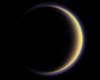
With its thick, distended atmosphere, Titan's orange globe shines softly, encircled by a thin halo of purple light-scattering haze. |
|
|

| The content herein, unless otherwise known to be public domain, are Copyright 1995-2006 - SpaceDaily.AFP and UPI Wire Stories are copyright Agence France-Presse and United Press International. ESA PortalReports are copyright European Space Agency. All NASA sourced material is public domain. Additionalcopyrights may apply in whole or part to other bona fide parties. Advertising does not imply endorsement,agreement or approval of any opinions, statements or information provided by SpaceDaily on any Web page published or hosted by SpaceDaily. Privacy Statement |