|
 |
 |
 |
 |
 |
 |
 |
 |

 |
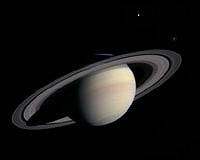
Saturn Mission Nearing Crucial Moment
London (SPX) Jun 04, 2004 Seven years of waiting comes to an end on 1 July when the Cassini spacecraft swoops closer to Saturn than any spacecraft previously. Researchers at Imperial College London will be anxiously awaiting the first signals that all has gone to plan during a 90-minute engine burning procedure known as Saturn Orbit Insertion, or SOI, and that their mission to definitively map the magnetic fields around Saturn has successfully begun. Never has a spacecraft been put in orbit around Saturn and not since Pioneer 11 and Voyagers 1 and 2 in 1981 has one passed so close. For the Imperial College scientists it represents the most critical moment of the mission, when they will be able to measure the internal magnetic field of Saturn and gain a better understanding of what the interior of the planet looks like. Cassini will approach Saturn from below, heading through Saturn's ring plane via a gap in the rings before flying up and over the planet just 0.3 planetary radii, or 20,000 kilometres, from Saturn's surface, and then diving down the other side, back through the ring plane again. The engine burn will slow Cassini allowing Saturn to grab the seven-tonne spacecraft, about the size of a two-storey building, and pull it into an orbit to begin its four-year mission to map every last detail of the planet's magnetosphere. "We'll be as close as we've ever been and getting an exquisite view of the planet and its ring system. We will also be doing some unique science on Saturn's magnetic field," says Dr Michele Dougherty, Principal Investigator of Cassini's MAG instrument, and Reader in Space Physics at Imperial College London. "MAG allows us to map the internal magnetic field of the planet, and will give us a better idea of what the interior of the planet is like, how the magnetic field is formed, how it is still being generated, and some further clues about how the solar system was formed." "To understand the environment around Saturn we need to understand its magnetic field. It's so important because the way the energetic particles and the plasma behave, all depends on what the field is doing. You can think of the magnetic field as the sinews of a body where everything hangs on how those sinews behave." During the manoeuvre data will be gathered but will not be beamed back to Earth until the spacecraft is in the clear. At about 16.00 BST on 1 July processed data should be ready for analysis by the team. The data arrives at the Jet Propulsion Laboratory in Pasadena, California, and is sent on by direct data line to the MAG team at Imperial College London. The Imperial College team will be first to receive and process the data from the two radio-sized devices on Cassini's 11-metre boom. The devices, together known as the magnetometer, are sensitive enough to detect fluctuations in the magnetic field due to the 'ticking' motion of the second hand on an engineer's wristwatch while it was being assembled, and could detect a mobile phone operating about 100 metres away from the spacecraft when in interplanetary space. They have four years of observations to come around Saturn, building up a detailed 3D map of the magnetic field around the planet. "It should give us the first new insight for 20 years into a central mystery about Saturn," explains Dr Dougherty. A surprising feature of Saturn's magnetic field is that the magnetic pole appears to lie exactly atop the geographical pole. This is unlike Earth and Jupiter where there is a large tilt between the planet's axis and the dipole axis, meaning that Earth's magnetic north is not located at the north pole. The MAG team also hope to gather data that establishes precisely how long Saturn takes to rotate. "At the moment we know it's ten and a half hours, but our error is seven seconds either way," says Dr Dougherty. "Over two years of observations that makes an error in longitude of 70 degrees. So in a sense we're trying to establish a reference frame of where zero degrees longitude is. This will mean we can accurately time the rotation and, intriguingly, establish whether the interior of Saturn is rotating at the same rate as the exterior." Cassini, a joint NASA/ESA mission, will fly past Saturn's moon Phoebe on June 11, and will detach the Huygens lander to descend on moon Titan on Christmas Eve, but for the Imperial College team the most critical event takes place during SOI on 1 July. "The MAG instrument is healthy," said Dr Dougherty, "as we know from the data we've been obtaining during the long cruise phase with flybys past Venus, the Earth and Jupiter." Before any commands to MAG are sent from London, the Imperial College team first tests them out on the flight spare instrument that sits in their laboratory. The MAG instrument was designed and built at Imperial in collaboration with colleagues and engineers from JPL and from Ultra Electronics, a UK contractor. Dr Dougherty and colleagues expect to have preliminary analyses of their SOI data ready by mid-July. Community Email This Article Comment On This Article Related Links Cassini at Imperial College Cassini at JPL SpaceDaily Search SpaceDaily Subscribe To SpaceDaily Express Explore The Ring World of Saturn and her moons Jupiter and its Moons The million outer planets of a star called Sol News Flash at Mercury
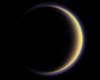
 Cassini Images Halo Around Titanic Moon Off Saturn
 Pasadena CA (SPX) Dec 27, 2005
With its thick, distended atmosphere, Titan's orange globe shines softly, encircled by a thin halo of purple light-scattering haze. |
|
|

| The content herein, unless otherwise known to be public domain, are Copyright 1995-2006 - SpaceDaily.AFP and UPI Wire Stories are copyright Agence France-Presse and United Press International. ESA PortalReports are copyright European Space Agency. All NASA sourced material is public domain. Additionalcopyrights may apply in whole or part to other bona fide parties. Advertising does not imply endorsement,agreement or approval of any opinions, statements or information provided by SpaceDaily on any Web page published or hosted by SpaceDaily. Privacy Statement |