|
 |
 |
 |
 |
 |
 |
 |
 |

 |
Saturn Kicks Out Super-Fast Dust Streams
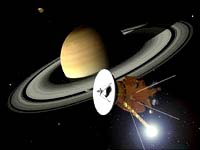
Paris (AFP) Jan 19, 2005 The US spacecraft Cassini ran into dramatic storms of dust as it hurtled towards its rendezvous with Saturn last year, a study published on Thursday says. The microscopic grains smashed into Cassini with an impact speed of more than 100 kilometers (62 miles) per second (360,000 kph, 225,000 mph) as the craft was ferrying the European probe Huygens towards Saturn last year. The dust probably came from the outermost ring of Saturn, called the A ring, the authors believe. Other possible sources were the planet's E ring, as well as dust clouds around the icy Saturnian moons of Dione and Rhea. The dust was first recorded by Cassini's onboard detectors about 60 million kms (37.5 million miles) from Saturn, and the bursts became more frequent and intense as the craft neared the rendezvous in July. The grains are believed to compose minute crystals of water ice which carry a positive electrical charge. They achieved their enormous velocity because they were flung into space by the mighty whirling magnetic field generated by Saturn, the authors suspect. Scientists had expected that Saturn may be spewing out dust because the phenomenon had already been spotted near Jupiter, where the main source of the particles is the Jovian moon Io. Lead author in the study, which appears in the British journal Nature, is Sascha Kempf of the Max Planck Institute for Nuclear Physics in Heidelberg, Germany. Huygens last Friday descended to the surface of Titan, carrying out an unprecedented array of experiments to assess its mysterious, thick atmosphere. Cassini-Huygens was launched in 1997, in a 3.2-billion-dollar (2.46-billion-euro) transatlantic venture to explore the second largest planet of the Solar System. Objects in space can reach enormous speeds because there is no friction. Meterorites enter the Earth's atmosphere at up to 72 kilometers (45 miles) per second, which causes them to burn up through friction with atmospheric molecules. Community Email This Article Comment On This Article Related Links SpaceDaily Search SpaceDaily Subscribe To SpaceDaily Express Explore The Ring World of Saturn and her moons Jupiter and its Moons The million outer planets of a star called Sol News Flash at Mercury
 Cassini Images Halo Around Titanic Moon Off Saturn
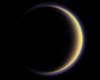 Pasadena CA (SPX) Dec 27, 2005
With its thick, distended atmosphere, Titan's orange globe shines softly, encircled by a thin halo of purple light-scattering haze. |
|
|

| The content herein, unless otherwise known to be public domain, are Copyright 1995-2006 - SpaceDaily.AFP and UPI Wire Stories are copyright Agence France-Presse and United Press International. ESA PortalReports are copyright European Space Agency. All NASA sourced material is public domain. Additionalcopyrights may apply in whole or part to other bona fide parties. Advertising does not imply endorsement,agreement or approval of any opinions, statements or information provided by SpaceDaily on any Web page published or hosted by SpaceDaily. Privacy Statement |