
 |
 |
 |
 |
 |
 |
 |
 |
 |

 |
Saturn Does The Wave In Upper Atmosphere
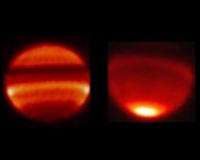
Pasadena CA (JPL) May 08, 2008 Two decades of scrutinizing Saturn are finally paying off, as scientists have discovered a wave pattern, or oscillation, in Saturn's atmosphere only visible from Earth every 15 years. The discovery of the wave pattern is the result of a 22-year campaign observing Saturn from Earth (the longest study of temperature outside Earth ever recorded), and the Cassini spacecraft's observations of temperature changes in the giant planet's atmosphere over time. The Cassini infrared results, which appear in the same issue of Nature as the data from the 22-year ground-based observing campaign, indicate that Saturn's wave pattern is similar to a pattern found in Earth's upper atmosphere. The earthly oscillation takes about two years. A similar pattern on Jupiter takes more than four Earth years. The new Saturn findings add a common link to the three planets. Just as scientists have been studying climate changes in Earth's atmosphere for long periods of time, NASA scientists have been studying changes in Saturn's atmosphere. Glenn Orton of NASA's Jet Propulsion Laboratory in Pasadena, Calif., says patience is the key to studying changes over the course of a Saturnian year, the equivalent of about 30 Earth years. "You could only make this discovery by observing Saturn over a long period of time," said Orton, lead author of the ground-based study. "It's like putting together 22 years worth of puzzle pieces, collected by a hugely rewarding collaboration of students and scientists from around the world on various telescopes." The wave pattern is called an atmospheric oscillation. It ripples back and forth within Saturn's upper atmosphere. In this region, temperatures switch from one altitude to the next in a candy cane-like, striped, hot-cold pattern. These varying temperatures force the wind in the region to keep changing direction from east to west, jumping back and forth. As a result, the entire region oscillates like a wave. A "snapshot" of the hot-cold temperature patterns in Saturn's atmosphere was captured by the Cassini Composite Infrared Spectrometer. Along with Earth-based data, the "snapshot" also uncovered other interesting phenomena. Among them: the temperature at Saturn's equator switches from hot to cold, and temperatures on either side of the equator switch from cold to hot every Saturn half-year. Mike Flasar, co-author of the Cassini paper, and principal investigator for Cassini's Composite Infrared Spectrometer at NASA's Goddard Space Flight Center, Greenbelt, Md., said that Cassini helped define this oscillation in combination with the ground observation campaign. "It's this great synergy of using ground-based data over time, and then getting up close and personal with the oscillation in Saturn's atmosphere through Cassini," said Flasar. "Without Cassini, we might never have seen the structure of the oscillation in detail." Cassini scientists hope to find out why this phenomenon on Saturn changes with the seasons, and why the temperature switchover happens when the sun is directly over Saturn's equator. Community Email This Article Comment On This Article Share This Article With Planet Earth
Related Links Cassini at JPL Cassini images Explore The Ring World of Saturn and her moons Jupiter and its Moons The million outer planets of a star called Sol News Flash at Mercury
 A Glorious Saturn Steps Into The Spotlight In New York City
 New York NY (SPX) May 06, 2008
In the four years since NASA's Cassini-Huygens spacecraft arrived at Saturn and began snapping pictures, Cassini's cameras have sent nearly 140,000 images back to researchers on Earth. |
|
|

| The content herein, unless otherwise known to be public domain, are Copyright 1995-2007 - SpaceDaily.AFP and UPI Wire Stories are copyright Agence France-Presse and United Press International. ESA Portal Reports are copyright European Space Agency. All NASA sourced material is public domain. Additional copyrights may apply in whole or part to other bona fide parties. Advertising does not imply endorsement,agreement or approval of any opinions, statements or information provided by SpaceDaily on any Web page published or hosted by SpaceDaily. Privacy Statement |
 del.icio.us
 Digg
Digg Reddit
 YahooMyWeb
 Google
 Facebook