|
 |
 |
 |
 |
 |
 |
 |
 |

 |
Satellite Wars And The Sands Of Iraq
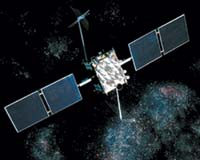
UPI Correspondent Washington (UPI) Jan 26, 2007 Right in the midst of the Bush administration's preparations to send even more American troops to Iraq came news that China successfully fired a missile to destroy one of its own satellites earlier this month. While Chinese officials insist this test was not targeted against any country and does not pose a threat, American officials are understandably concerned. American armed forces heavily depend on satellites. Satellites, however, are vulnerable to missile attack. China's anti-satellite test raises the ominous possibility that Beijing, despite its protestations to the contrary, is developing the capacity to damage or destroy America's military satellite infrastructure. Whether China would ever actually do so is not clear, but just the growing perception that it could might serve to make the United States more cautious and hesitant about responding forcefully to growing Chinese assertiveness. The fact that the Chinese are working on an anti-satellite capability at a time when the U.S. government is devoting so much energy and resources to Iraq reminds me of something similar that occurred during the Cold War. At the start of the American military buildup in Vietnam in 1964, the American nuclear arsenal was larger than that of the Soviet Union. By the time the United States withdrew from Indochina in 1973, though, the Soviet nuclear arsenal was larger than America's. What happened back then was that Moscow took advantage of America's being bogged down in Vietnam to build up its nuclear weapons capacity. While the United States was aware of what the Soviets were doing, the war in Indochina had become a higher priority for the Johnson and Nixon administrations than the nuclear competition -- and they allocated overstretched American resources accordingly. Similarly, the United States is now very much aware of China's growing anti-satellite capability. Adequately defending against it will take considerable energy and resources. But the unfortunate reality is that it is far easier and cheaper to launch a missile attack than to successfully defend against one. Any credible effort to defend America's satellites against missile attack, whether by China or any other country, will be very costly in terms of both money and dedicated attention from policymakers. With America currently bogged down in Iraq, however, the money and attention needed for satellite defense are simply not available. And so China is able to proceed with the development of its anti-satellite capability without America responding to it as aggressively as it might if the United States were not so heavily involved in Iraq. In his 1987 book entitled "Vietnam and the Soviet Union: Anatomy of an Alliance," Indochina expert Douglas Pike estimated that during the height of America's involvement in Vietnam (1965-73), Moscow was giving Hanoi $150-390 million per year in economic aid and $110-$650 million per year in military aid. This was not a high price for Moscow to pay in order to distract Washington from responding to the Soviet nuclear buildup. Yet China is getting a much better deal since Beijing isn't giving any support to the various anti-American groups in Iraq that are distracting Washington from adequately responding to the development of China's anti-satellite capability. More than anything else, China's successful anti-satellite test shows that Iraq is not the only military challenge America faces. It might not be the most important one either. (Mark N. Katz is a professor of government and politics at George Mason University.)
Source: United Press International Community Email This Article Comment On This Article Related Links Iraq: The first technology war of the 21st century Military Space News at SpaceWar.com Read More About the Chinese Space Program Follow the rise and rise of the second hyperpower at SinoDaily.com Military Space News at SpaceWar.com
 India To Set Up Aerospace Defence Command
 New Delhi (AFP) Jan 28, 2007
India will set up an aerospace defence command to shield itself against possible attacks from outer space, officials said Sunday. The announcement came three days after Russia backed India's response to a Chinese satellite-destroying weapons test that demanded a "weapons free outer space." Indian Air Force (IAF) chief Shashi Tyagi said it was in the process of establishing an aerospace defence command "to exploit outer space," the Press Trust of India (PTI) news agency reported. |
|
|

| The content herein, unless otherwise known to be public domain, are Copyright 1995-2006 - SpaceDaily.AFP and UPI Wire Stories are copyright Agence France-Presse and United Press International. ESA PortalReports are copyright European Space Agency. All NASA sourced material is public domain. Additionalcopyrights may apply in whole or part to other bona fide parties. Advertising does not imply endorsement,agreement or approval of any opinions, statements or information provided by SpaceDaily on any Web page published or hosted by SpaceDaily. Privacy Statement |