|
 |
 |
 |
 |
 |
 |
 |
 |

 |
Satellite Tracking Reveals Migratory Mysteries Of Atlantic Loggerhead Turtles
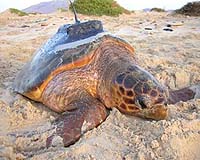
Exeter UK (SPX) May 24, 2006 Their journeys are among the longest in the animal kingdom and they have largely remained a mystery until now. An international team of scientists led by the University of Exeter have uncovered the migratory secrets of endangered loggerhead turtles in West Africa and the results could have huge implications for strategies to protect them. In a paper in the journal Current Biology, Dr Brendan Godley and an international team describe how they used satellite tracking systems to follow the journeys of ten turtles from Cape Verde, West Africa, which is one of the world's largest nesting sites for loggerheads and a hotspot for industrial fishing. What they found could turn current conservation strategies upside down, as the team discovered the turtles adopted two distinct approaches to finding food, linked to their size. Previously it was thought that hatchlings left the coastal region to forage far out at sea before returning, later in life, to find food closer to shore. However the new findings show that the oceanic habitats contained far larger animals than was previously thought. The team tracked the turtles as they left nesting sites, following them for up to two years over ranges that covered more than half a million square kilometres. Dr Brendan Godley, of the University of Exeter, said: "We were surprised to find such large turtles looking for food out in the open ocean, as it was previously thought that animals of this size would have moved back to forage in coastal zones. This means there are much greater numbers of the breeding population out at sea and far more that are vulnerable to the intensive longline fishing effort that occurs in that region." Dr Michael Coyne, of Duke University, added: "From the information collected, we have been able to determine how much time these animals are spending within the sovereign boundaries of each country in the region. This research highlights how complicated the migration of marine vertebrates really is and how sophisticated our conservation efforts must be to safeguard these animals. Given the range these reptiles can cover an international cooperative effort in seven African states is needed to create a strategy that would protect them." Research* shows that in 2000 1.4 billion hooks were cast into the world's oceans through industrial fishing. It's thought that globally more than 200,000 loggerhead turtles were incidentally caught by fisherman scouring the waters for other species such as tuna and swordfish. Of these, tens of thousands are thought to die as a result. 37 percent of this fishing effort was in the Atlantic and a major hotspot for fishing is found off West Africa, the region where the Cape Verdean turtles reside. In recent years marine turtle researchers have been using satellite telemetry to track turtle migrations. Satellite transmitter tags are attached to the shell of the turtle so that every time the turtle surfaces to breathe, the tag transmits the turtle's position, as well as other information (e.g. depth and duration of dives), to satellites orbiting above, which then relay the data by e-mail to the computer of the scientist who attached the tag. For more information about tracking sea turtles, visit http://www.seaturtle.org/tracking Community Email This Article Comment On This Article Related Links University of Exeter The Marine Turtle Research Group Darwin Today At TerraDaily.com
 Brazil Creates Buffer Zone Around Coral Reefs Off Atlantic Coast
 Brasilia, Brazil (SPX) May 24, 2006
The Brazilian government has created an official buffer zone around the Abrolhos National Marine Park to protect the biologically richest coral reefs in the South Atlantic. |
|
|

| The content herein, unless otherwise known to be public domain, are Copyright 1995-2006 - SpaceDaily.AFP and UPI Wire Stories are copyright Agence France-Presse and United Press International. ESA PortalReports are copyright European Space Agency. All NASA sourced material is public domain. Additionalcopyrights may apply in whole or part to other bona fide parties. Advertising does not imply endorsement,agreement or approval of any opinions, statements or information provided by SpaceDaily on any Web page published or hosted by SpaceDaily. Privacy Statement |